
Introduction: The Price of Staying Safe
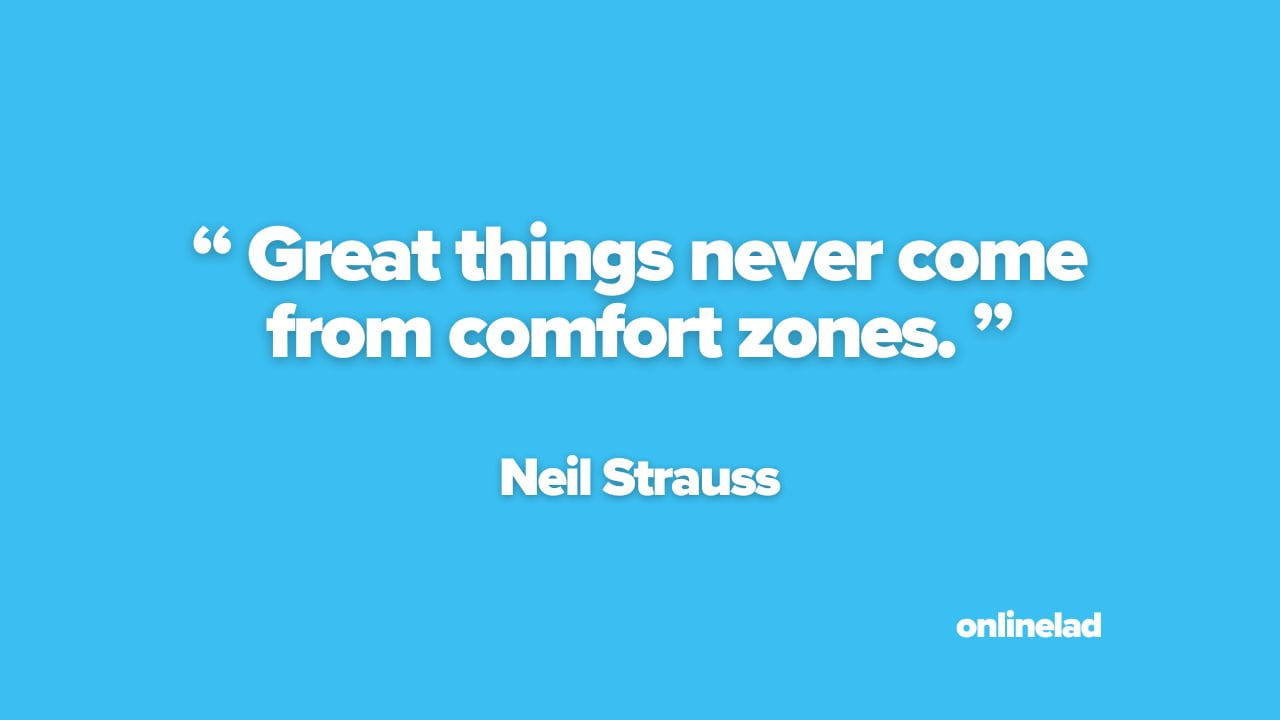
“Great things never come from comfort zones.” The words are direct, almost confrontational in their simplicity. Attributed to Neil Strauss, the quote feels less like a motivational slogan and more like a quiet challenge. It asks something uncomfortable of us: Are we choosing ease over evolution?
In modern life, comfort is marketed as the ultimate goal. Faster delivery. Softer mattresses. Safer opinions. Predictable routines. We are encouraged to optimise for convenience and minimise friction at every turn. Yet deep down, most people sense a quiet dissatisfaction that comfort alone cannot fix. We crave progress, meaning, momentum. We want to feel capable, alive, expanding.
This is where Strauss’s words land with force. They resonate because they expose a tension we all feel. We want extraordinary results, but we hesitate at extraordinary effort. We admire courage in others while negotiating with fear in ourselves. We talk about change while clinging to familiarity.
For the @onlinelad audience, the quote touches on something deeper than ambition. It speaks to identity. To masculinity that is defined not by noise or dominance, but by the willingness to confront discomfort in pursuit of growth. It challenges the idea that safety equals success. It suggests that comfort is not the enemy, but it is rarely the birthplace of greatness.
The question is not whether comfort feels good. It does. The question is whether staying there costs us something far more valuable.
Quote in Context
Neil Strauss, known for his explorations of psychology, relationships, status and self-transformation, has built a career around studying human behaviour under pressure. Whether writing about seduction, fame, addiction, or reinvention, his work often centres on what happens when people push beyond their perceived limits.
This quote reflects that theme. It is less about bravado and more about exposure. Strauss has consistently highlighted that personal evolution requires stepping into environments that stretch identity. Growth demands friction. Confidence is not built by rehearsing what you already know, but by risking what you do not.
In cultural terms, the quote arrived at a time when self-development became mainstream. Social media amplified aspiration. Hustle culture glorified grind. Yet beneath the surface, many people were paralysed by comparison and fear. The idea of leaving a comfort zone began to mean more than career risk. It meant emotional risk. Social risk. Romantic risk. The risk of being seen.
What makes this quote endure is that it feels experiential. It does not read like theory. It sounds like observation. Anyone who has built a business, committed to fitness, pursued a difficult relationship, or reinvented themselves socially understands its truth. Every meaningful shift required discomfort first.
Strauss’s message is not reckless. It does not romanticise chaos. It simply points out a universal law: stagnation hides inside familiarity. Progress waits beyond it.
Finding the Deeper Meaning
At its core, the quote is about psychological expansion. Comfort zones are not physical spaces. They are mental boundaries. They are stories we tell ourselves about what we can handle, who we are, and what we deserve. Staying inside them preserves identity. Stepping outside them reshapes it.
Discomfort is often misinterpreted as danger. In reality, it is frequently a signal of growth. The anxiety before a difficult conversation. The nerves before public speaking. The vulnerability of expressing genuine interest in someone. These sensations are not signs to retreat. They are thresholds.
For modern men especially, there is a tension between appearing composed and embracing vulnerability. Comfort zones can become emotional armour. We avoid rejection by not trying. We avoid failure by not starting. We avoid judgement by staying silent. It feels safe. It also limits potential.
Resilience is forged in exposure. Confidence is built through repetition of uncomfortable action. Ambition becomes real when it is paired with disciplined discomfort. This is not about chasing pain for its own sake. It is about understanding that self-respect grows when you prove to yourself that you can endure temporary unease in exchange for long-term gain.
The deeper meaning of Strauss’s quote is not that comfort is bad. It is that comfort is a resting place, not a destination. Growth requires intentional friction. Identity requires challenge. Greatness, in any domain, demands the courage to step into uncertainty and stay there long enough to expand.
Great things are rarely loud in the beginning. They start quietly, often in moments where you choose discomfort over ease. That decision, repeated consistently, is where transformation lives.
Relevance to Modern Life
In a world built around convenience, comfort has become the default setting. We scroll instead of speak. We delay difficult conversations. We stay in jobs that feel tolerable rather than purposeful. We entertain ambitions privately while publicly presenting stability. On the surface, everything looks fine. Underneath, there is often a quiet restlessness.
“Great things never come from comfort zones” is not a call to abandon security or act recklessly. It is a reminder that progress rarely happens in autopilot. In relationships, this can mean risking honesty instead of maintaining polite distance. It can mean expressing genuine interest instead of performing indifference. Emotional safety is important, but emotional avoidance is something else entirely. The strongest connections are built when someone chooses vulnerability over pride.
At work, the comfort zone often looks like competence without stretch. You know your role. You know what is expected. You deliver. But you also know you are capable of more. The tension between comfort and growth appears in the decision to speak up in a meeting, to ask for greater responsibility, or to pursue an opportunity that feels slightly beyond your current level. It is not dramatic. It is subtle. Yet those subtle decisions compound.
Confidence itself is shaped in discomfort. Real confidence is not the absence of nerves. It is the memory of having faced them before. Every time you choose the harder conversation, the disciplined routine, the honest standard, you reinforce your own self-trust. Over time, your comfort zone expands, but only because you were willing to challenge it first.
Modern life offers endless distraction from discomfort. It offers entertainment instead of introspection and validation instead of self-examination. The quote cuts through that noise. It quietly asks whether your current comfort is protecting you or limiting you. The answer is rarely obvious, but it is always personal.
Applying the Message Personally
Most people do not struggle because they lack ambition. They struggle because they overthink the step that feels uncomfortable. Doubt rarely shouts. It whispers reasonable excuses. Not yet. Maybe later. What if it goes wrong. These thoughts feel protective, even intelligent. But they often disguise fear of growth.
Applying this message does not require dramatic reinvention. It begins in ordinary moments. The moment you choose to train when you would rather rest. The moment you send the message instead of analysing it for the tenth time. The moment you admit you want more from your career or your relationship rather than pretending you are satisfied.
Stagnation rarely feels like failure. It feels like safety. That is why it can last so long. You can live in a comfort zone for years without obvious consequences. Yet internally, something feels underused. Potential unused does not disappear. It lingers.
The key is not to eliminate fear but to reinterpret it. Discomfort is often evidence that you are stretching beyond your previous identity. It signals that you are operating at the edge of growth. If you learn to tolerate that sensation rather than retreat from it, you begin to change your self-image. You stop seeing yourself as someone who avoids risk and start seeing yourself as someone who handles it.
This week, choose one small action that makes you slightly uncomfortable but aligns with who you want to become. Not something extreme. Something deliberate. Initiate the conversation. Raise your standard. Begin the routine. Let the discomfort exist without negotiating it away.
Growth is rarely a single leap. It is a series of small, uncomfortable decisions made consistently. Each one quietly reshapes your identity.
Conclusion: Where Growth Begins
Neil Strauss’s words return us to a simple truth. Comfort feels good, but it rarely changes us. Growth requires exposure. It requires the willingness to feel uncertain without retreating into familiarity.
Greatness, in any form, is built on moments where someone chose expansion over ease. It is built on the decision to act despite doubt, to speak despite nerves, to pursue despite risk. These moments often feel insignificant at the time. In hindsight, they define everything.
You do not need chaos to grow. You need intention. You need standards that challenge you. You need the courage to step forward when staying still would be easier. Over time, that courage becomes part of your character.
“Great things never come from comfort zones.” It is not a slogan to shout. It is a reminder to remember. When faced with a choice between safe and stretching, ask yourself which version of you you are building.
Comfort is a place to rest. It is not a place to live.