
Introduction: Courage Begins With Belief
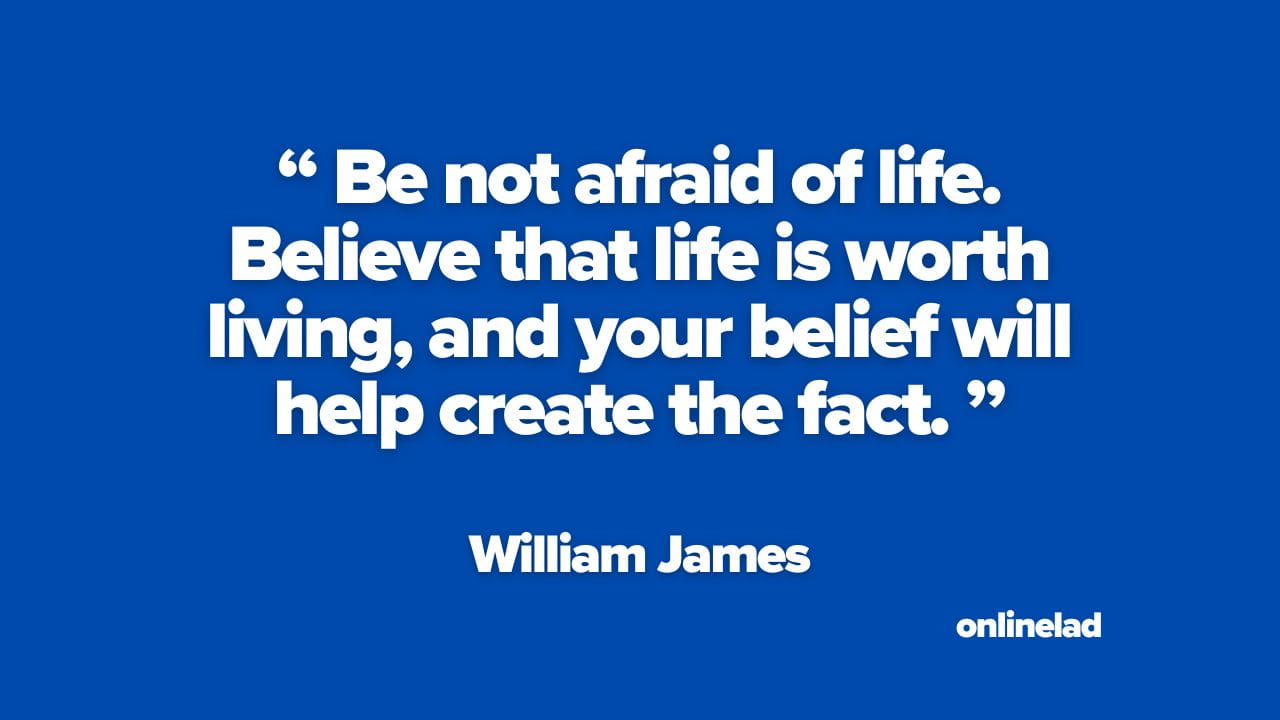
William James once wrote, “Be not afraid of life. Believe that life is worth living, and your belief will help create the fact.” It is a deceptively simple line, but one that carries serious weight in a world where confidence is constantly tested and certainty feels increasingly rare. At a time when many people are quietly wrestling with doubt, comparison, and the pressure to have everything figured out, this quote lands not as optimism for optimism’s sake, but as a practical philosophy for living.
Modern life is loud. We are surrounded by narratives that reward certainty, speed, and visible success, while leaving little space for hesitation, reflection, or gradual growth. Against that backdrop, James’s words feel quietly rebellious. He is not promising that life will be easy, fair, or predictable. Instead, he suggests something more subtle and far more challenging: that belief itself is an active force, shaping how we experience the world and what we are capable of creating within it.
For many, fear of life does not come from danger in the traditional sense, but from emotional exposure. Fear of failing. Fear of choosing wrongly. Fear of being seen trying and not quite making it. James’s quote speaks directly to this inner tension. It reframes belief not as blind hope, but as a decision to engage with life rather than stand at a safe distance.
This idea resonates deeply today because so many people are living cautiously, waiting for the right moment, the right confidence, or the right permission to step fully into their own lives. James invites us to consider the opposite approach. What if belief is not the result of evidence, but the starting point? What if trusting that life is worth the effort is what allows meaning, momentum, and confidence to emerge in the first place?
Quote in Context
William James was not a motivational speaker or a self-help guru. He was a philosopher and psychologist, widely regarded as one of the founders of modern psychology and pragmatism. Writing in the late nineteenth and early twentieth centuries, James was deeply interested in how belief, action, and experience interact. His work explored how ideas are not just abstract thoughts, but tools that shape how we live.
This quote reflects James’s broader philosophy of pragmatism, the idea that the truth of a belief is found in its practical effects. In other words, what we believe matters not only because it might be objectively true, but because it changes how we act, persevere, and interpret our experiences. For James, believing that life is worth living was not naive optimism. It was a functional stance, one that made engagement, effort, and growth possible.
At the time, James was writing in an era of rapid change, industrialisation, and shifting social structures. Traditional sources of certainty, religion, rigid social roles, inherited identities, were being questioned. Many people felt unmoored, unsure of what to trust or how to orient themselves in a changing world. In that sense, his words feel strikingly modern.
James understood that humans do not operate purely on logic. We act on hope, fear, meaning, and expectation. If someone believes life is empty or hostile, they withdraw. They hesitate. They protect themselves by disengaging. If they believe life holds possibility, even without guarantees, they are more likely to participate, to take risks, and to persist through difficulty.
This quote matters because it frames belief as a choice with consequences. It suggests that waiting for life to prove its worth before committing to it may be backwards. Instead, meaning is often something we generate through belief, action, and continued involvement, even when certainty is absent.
Finding the Deeper Meaning
At its core, this quote is about responsibility for one’s inner stance toward life. “Be not afraid of life” is not a denial of hardship, loss, or uncertainty. It is an invitation to stop letting fear dictate how much of life we are willing to inhabit. Fear shrinks possibilities. Belief expands them.
The second part of the quote is where its real power lies. “Your belief will help create the fact.” This is not mystical thinking. It is psychological realism. When you believe life is worth engaging with, you show up differently. You invest effort. You stay present during difficulty rather than numbing or withdrawing. Over time, those choices accumulate into experiences that feel meaningful, reinforcing the original belief.
In modern life, many people struggle with a quiet sense of disconnection. They do the right things on paper, work, relationships, routines, yet feel oddly detached from their own lives. James’s insight speaks directly to this. Without belief, discipline becomes hollow. Ambition feels forced. Confidence never quite settles. Belief is the emotional soil that allows effort to take root.
There is also a subtle message here about patience and self-worth. Believing life is worth living does not require immediate success or constant happiness. It requires faith in process. Faith that showing up today matters, even if the payoff is unclear. This mindset is especially relevant in an age obsessed with outcomes and instant validation.
Ultimately, James reminds us that life does not always meet us halfway first. Sometimes, we have to step forward before meaning reveals itself. Belief is not the reward for a life well lived. It is often the starting point. Choosing to believe that life is worth the effort is an act of quiet courage, one that shapes identity, resilience, and the depth with which we experience our own existence.
Relevance to Modern Life
In modern life, fear rarely announces itself as fear. It shows up as hesitation, over-analysis, and the quiet habit of waiting. Waiting to feel ready. Waiting to feel confident. Waiting for clearer signs that a decision will work out. William James’s insight cuts through this pattern with disarming clarity. Believing that life is worth living is not about positivity. It is about orientation. It is about how you position yourself in relation to uncertainty.
In relationships, this belief shows up as emotional availability. Many people want connection but approach it defensively, expecting disappointment before intimacy even begins. When life feels inherently risky, it becomes easier to keep options open, to withhold effort, or to stay detached. Believing that life is worth engaging with changes that posture. It does not guarantee the right outcome, but it makes sincerity possible. It allows you to show up honestly rather than strategically.
At work, the same principle applies. A belief that effort is futile or that the system is rigged tends to produce cautious ambition. People do enough to stay afloat, but rarely enough to feel fulfilled. When you believe your actions can shape reality, even imperfectly, work becomes less about survival and more about contribution. You take responsibility for your growth instead of outsourcing meaning to promotions, recognition, or timing.
Confidence, too, is often misunderstood as something you acquire before acting. James flips that logic. Confidence is frequently the by-product of engagement, not the prerequisite. Belief comes first, not certainty. This matters in an era where comparison culture makes self-trust fragile. If you are constantly measuring your progress against others, belief erodes. James’s message is a reminder that your internal stance matters more than external noise.
Believing life is worth living does not mean ignoring hardship. It means refusing to let hardship define your relationship with life itself. That distinction is subtle, but it changes everything.
Applying the Message Personally
On a personal level, this quote invites an honest look at how you respond to uncertainty. Most people do not lack ability or opportunity. They lack permission, permission they are waiting to receive from circumstances, confidence, or someone else’s approval. James suggests that belief is the permission.
In everyday life, this shows up in small decisions. Do you reach out or stay silent. Do you start the project or keep refining the plan. Do you say what you actually think or soften it to avoid friction. Doubt often masquerades as thoughtfulness, but prolonged hesitation usually signals fear of committing to a direction.
Believing that life is worth living means trusting that action itself has value, even when outcomes are unclear. It means accepting that progress often feels messy from the inside. Many people overthink not because they are careful, but because they are afraid of choosing wrongly. James’s insight offers relief here. You do not need certainty to move forward. You need belief that engagement will teach you more than avoidance ever could.
This belief also reshapes how you treat yourself. When life feels worthwhile, mistakes become information rather than verdicts. You stop interpreting every setback as proof of inadequacy and start seeing it as part of participation. That shift is subtle, but deeply stabilising.
A simple way to apply this message this week is to identify one area where you have been waiting for clarity and take a modest step anyway. Not a dramatic leap, just movement. Send the message. Book the session. Start the draft. Let action, rather than rumination, do some of the thinking for you.
Belief does not demand blind faith. It asks for willingness. Willingness to participate before you feel ready. Willingness to trust that engagement itself creates meaning.
Conclusion: Choosing Engagement Over Fear
William James’s words endure because they speak to a tension that never disappears. The tension between caution and courage, between waiting and living. “Be not afraid of life” is not a command to ignore fear. It is an invitation to stop organising your life around it.
Believing that life is worth living is a quiet, deliberate stance. It does not require constant optimism or relentless ambition. It requires a decision to engage rather than retreat, to participate rather than spectate. Over time, that decision shapes how life feels from the inside.
When belief leads, action follows. When action follows, experience accumulates. And when experience accumulates, life gradually becomes richer, not because it was guaranteed to be, but because you allowed yourself to meet it fully.
As a closing thought, James’s quote can be held as a simple mantra. Believe that life is worth living. Let that belief guide your choices. Then watch how often the fact begins to take shape around you.