
Introduction: Why Doubt Shapes the Future Before It Arrives
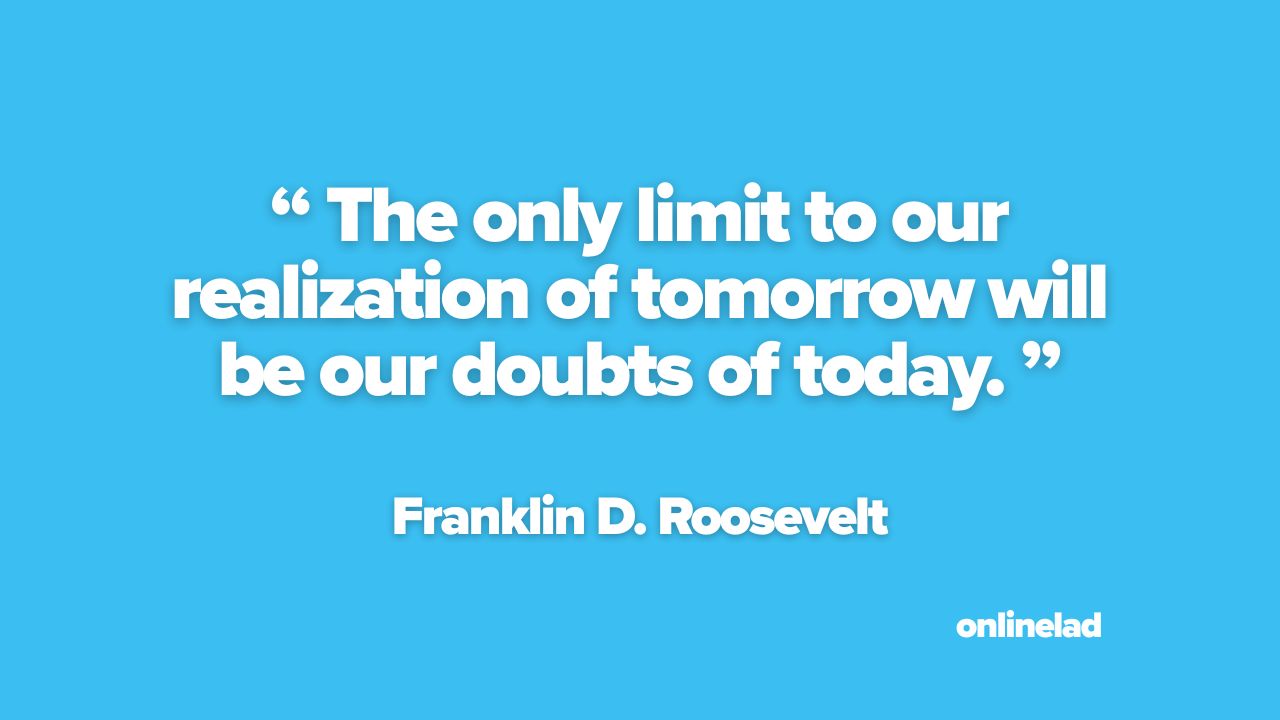
“The only limit to our realization of tomorrow will be our doubts of today.” At first glance, the words feel calm, almost reassuring. There is no bravado here, no chest-thumping motivation. Instead, Franklin D. Roosevelt offers something far more unsettling and far more powerful: the idea that the future is rarely blocked by circumstance, but by what we quietly tell ourselves when no one else is listening.
This quote continues to resonate because modern life has perfected the art of doubt. We are surrounded by comparison, performance metrics, curated success stories, and constant reminders of how far ahead others appear to be. Doubt no longer announces itself as fear. It disguises itself as realism. As caution. As being sensible. We tell ourselves we are not doubting, we are just being honest.
For many men navigating ambition, relationships, identity, and self-belief, this hits close to home. Doubt creeps in before action is taken. Before risks are explored. Before confidence has a chance to form through experience. It whispers that now is not the right time, that you are not ready, that others are better equipped, more qualified, more deserving.
What makes this quote compelling is not that it promises success. It does not suggest tomorrow will be easy or guaranteed. Instead, it points to something more controllable and more uncomfortable: the inner narrative shaping our choices today. Roosevelt reminds us that the future is not delayed by lack of talent or opportunity as often as it is stalled by hesitation.
This idea feels especially relevant in an age where potential is everywhere but conviction feels scarce. The quote invites a grounded reflection. Not on what tomorrow might bring, but on what today’s doubts are quietly taking away.
Quote in Context
Franklin D. Roosevelt was not a man offering advice from the sidelines. He led during periods of deep uncertainty, from the Great Depression to the Second World War, when fear was not abstract but woven into everyday life. Economic collapse, global conflict, and social instability were not hypothetical threats. They were lived realities.
When Roosevelt spoke about doubt limiting tomorrow, he was addressing a nation paralysed by fear. Jobs were scarce. Confidence was broken. Trust in institutions had eroded. The temptation to retreat, to wait for perfect conditions, was strong. His leadership focused less on pretending everything was fine and more on restoring belief in collective and individual agency.
This context matters because it reframes the quote as practical wisdom rather than motivational optimism. Roosevelt was not denying hardship. He was challenging the idea that fear should be allowed to dictate the future. His message was simple but demanding: progress requires movement, and movement requires belief, even when certainty is absent.
In modern culture, the quote often appears on minimalist backgrounds or social media posts, stripped of its weight. But its origins are rooted in moments when doubt had very real consequences. Inaction did not just slow progress. It deepened suffering.
Seen this way, the quote is not about dreaming bigger for the sake of ambition. It is about responsibility. About recognising how internal hesitation compounds external difficulty. Roosevelt understood that confidence is not arrogance. It is a necessary ingredient for survival, leadership, and change.
When read in context, the quote becomes less inspirational and more confrontational. It asks whether doubt is serving you or quietly shaping a smaller future than the one available.
Finding the Deeper Meaning
At its core, this quote challenges the relationship between belief and action. Doubt does not usually stop us outright. It delays. It softens decisions. It convinces us to wait. Over time, those small pauses become patterns, and those patterns become limits.
The deeper meaning lies in recognising that confidence is not something you acquire before you act. It is something that forms through action itself. Doubt demands proof before movement. Growth demands movement before proof. This tension sits at the heart of ambition, discipline, and self-worth.
Psychologically, doubt often stems from fear of identity loss. What if you try and fail. What if you are exposed. What if success changes you. These fears rarely present as panic. They show up as procrastination, over-planning, or convincing yourself you do not care that much anyway.
In relationships, doubt can look like emotional distance or reluctance to be vulnerable. In careers, it appears as staying comfortable rather than fulfilled. In personal growth, it becomes endless preparation with no execution. The quote speaks to all of these experiences without naming them directly.
There is also a quieter theme here about patience and self-trust. Realising tomorrow does not mean forcing outcomes. It means trusting yourself enough to take the next step without needing absolute certainty. Discipline grows when you show up despite doubt. Confidence grows when you keep promises to yourself.
Ultimately, Roosevelt’s words remind us that doubt is not a flaw to eliminate but a signal to examine. When doubt becomes the decision-maker, tomorrow shrinks. When belief is allowed to lead, even cautiously, the future expands in ways that cannot be predicted from the safety of today.
The limit, as he suggests, is rarely external. It is the moment we decide whether doubt will be a voice we listen to or one we move through.
Relevance to Modern Life
In modern life, doubt rarely announces itself loudly. It settles in quietly, blending into routine and passing itself off as practicality. We call it being sensible. We call it weighing options. We call it waiting for the right time. Yet beneath those reasonable labels, doubt often acts as a subtle governor on how fully we show up in our own lives.
In relationships, this can look like holding back honesty because it feels safer not to risk discomfort. You might delay saying what you feel, not because the feeling is unclear, but because you fear the outcome. Doubt tells you that protecting yourself now is wiser than discovering what could exist later. Over time, that hesitation can erode connection more effectively than any argument ever could.
At work, doubt often masquerades as professionalism. You wait to be noticed rather than stepping forward. You keep ideas quiet until they feel flawless. You stay in roles that no longer fit because they offer certainty, even when that certainty feels increasingly empty. The quote speaks directly to this kind of slow erosion, where tomorrow’s potential is quietly traded for today’s comfort.
Confidence in modern life is also shaped by constant comparison. Social feeds and professional networks expose us to polished versions of other people’s progress, rarely showing the uncertainty beneath. Doubt grows in these gaps. You start to believe everyone else feels more certain, more prepared, more deserving. The truth is that most people move forward while doubting themselves, not after doubt disappears.
What makes Roosevelt’s words feel so relevant now is their refusal to blame circumstance alone. They suggest that while we cannot control every condition around us, we have more influence than we think over how much doubt dictates our direction. This is not about forcing optimism. It is about recognising where hesitation has quietly become a habit, and where that habit is shaping a smaller life than necessary.
Applying the Message Personally
Applying this message personally begins with noticing how doubt shows up in your everyday decisions. Not the dramatic moments, but the small ones. The email you rewrite five times but never send. The conversation you plan but postpone. The opportunity you downplay before it ever asks anything of you.
Doubt thrives in overthinking. It convinces you that clarity must come before movement. In reality, clarity often follows action. Most progress is made while feeling uncertain, not after uncertainty has been resolved. Waiting until you feel ready can quietly become a lifelong delay.
This does not mean ignoring caution or acting recklessly. It means questioning whether doubt is protecting you or limiting you. There is a difference between thoughtful restraint and habitual hesitation. The former is rooted in values. The latter is rooted in fear of exposure, failure, or change.
Personal growth rarely requires grand gestures. It usually begins with one honest step. Saying what you mean. Applying even when the outcome is unclear. Setting a standard for yourself that does not depend on external validation. These actions build trust with yourself, and that trust weakens doubt’s grip.
A simple, realistic takeaway to reflect on this week is this: identify one decision you have been postponing purely because you do not feel ready. Ask yourself what the smallest forward action would look like, not the perfect one. Then do that. Send the message. Start the draft. Have the conversation.
The goal is not immediate success. It is momentum. When you move despite doubt, you teach yourself that uncertainty is survivable. That lesson compounds far more powerfully than waiting ever could.
Conclusion: Choosing Belief Over Hesitation
Franklin D. Roosevelt’s words endure because they speak to a quiet truth most people recognise but rarely confront. The future is not usually blocked by lack of ability, opportunity, or intelligence. It is limited by the stories we tell ourselves about what we are allowed to attempt.
Doubt will always exist. It is part of being thoughtful, self-aware, and human. The danger lies in allowing it to become the deciding voice rather than one perspective among many. When doubt takes control, tomorrow narrows. When belief leads, even cautiously, the horizon widens.
This is not a call to blind confidence or constant striving. It is an invitation to self-trust. To act without waiting for certainty. To understand that growth often feels uncomfortable precisely because it requires leaving familiar ground.
As a closing reflection, the quote stands well on its own: the only limit to our realization of tomorrow will be our doubts of today. Not as a demand to be fearless, but as a reminder that belief is a choice we make repeatedly, often in small moments that never make headlines.
Choose belief often enough, and tomorrow begins to look less like a distant idea and more like something already taking shape.