
Introduction: When the Cold Outside Meets the Fire Within
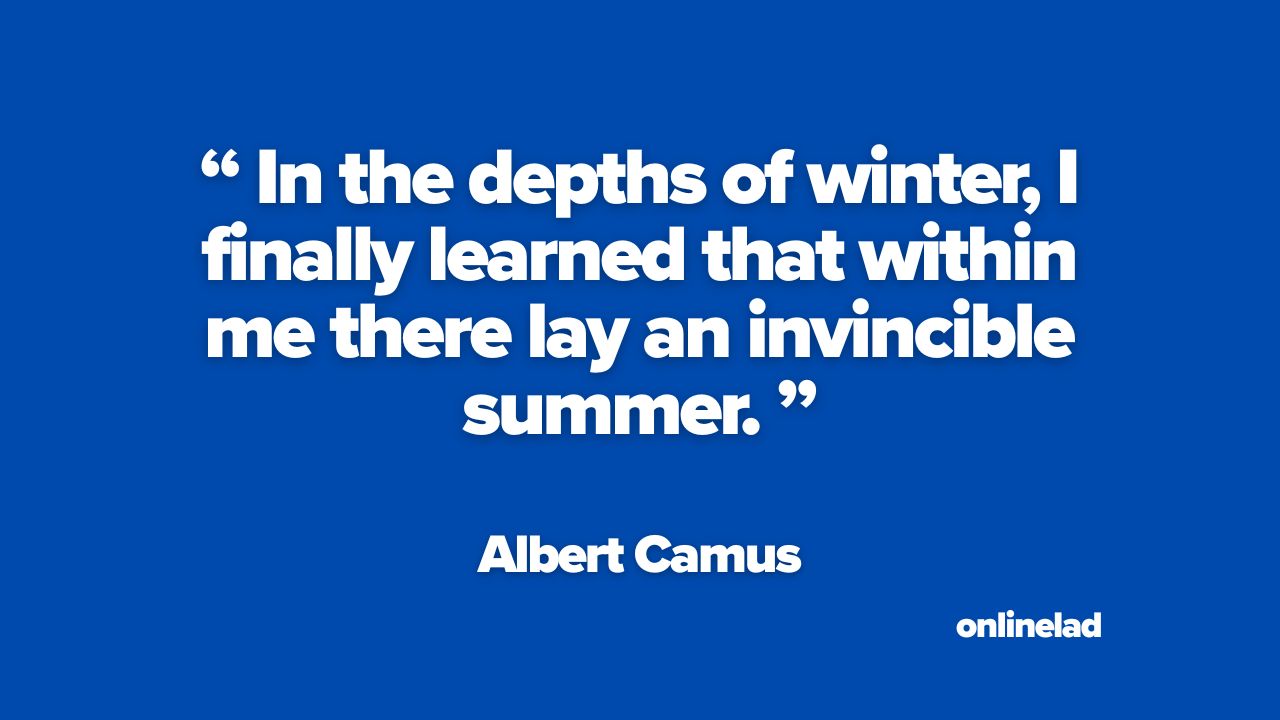
“In the depths of winter, I finally learned that within me there lay an invincible summer.” Few lines capture quiet resilience as powerfully as these words from Albert Camus. They are not loud or motivational in the modern sense. They do not shout about hustle or domination. Instead, they speak to something steadier and more enduring: the discovery of inner strength when everything around you feels stripped bare.
In today’s world, where success is measured in public metrics and confidence is often confused with volume, Camus offers a different kind of power. His quote resonates because it speaks to moments most of us rarely broadcast. The job loss that tests your identity. The relationship that ends and leaves you questioning your worth. The silent battle with self-doubt when everyone else appears to be thriving. Winter, in this sense, is not a season. It is a state.
What makes this line endure is not its poetry alone, but its honesty. It acknowledges darkness without romanticising it. There is no denial of the cold. No pretending that hardship does not sting. Instead, it suggests that hardship reveals something deeper within us, something we may not have known existed.
For readers navigating ambition, relationships, modern masculinity, or personal reinvention, this quote lands with force. It hints that strength is not the absence of struggle, but the discovery of something unshakeable beneath it. And that discovery often happens when comfort disappears.
Quote in Context
Albert Camus, the French philosopher and writer often associated with existentialism and absurdism, understood winter in more ways than one. Born in Algeria in 1913 and later writing through the turbulence of war and political upheaval in Europe, Camus grappled with questions of meaning in a world that often felt indifferent or chaotic. His works, including novels like The Stranger and essays such as The Myth of Sisyphus, explore how individuals respond to suffering, injustice, and existential doubt.
This particular line is widely attributed to Camus and captures the spirit of his thinking, even if it does not appear neatly packaged in one of his major philosophical texts. It reflects a theme central to his worldview: that human beings possess a quiet defiance against despair. Not through grand declarations, but through endurance.
Camus believed life could be absurd. Not meaningless, but unpredictable and often unfair. The “winter” he describes is not simply hardship. It is the confrontation with reality when illusions fall away. When the world does not bend to our expectations. When outcomes do not match effort.
Yet within that confrontation, he suggests, lies discovery. The invincible summer is not naïve optimism. It is a deeper awareness of one’s own capacity. A recognition that even when circumstances are cold, there remains a core that cannot be extinguished. This was not philosophy from comfort. It was philosophy forged in uncertainty, conflict, and personal introspection.
That is why the quote endures. It is not a slogan. It is lived wisdom.
Finding the Deeper Meaning
At its core, Camus’ quote speaks to identity under pressure. Many of us define ourselves by external conditions. Career progress. Relationship status. Financial stability. Social approval. When those pillars shake, so does our sense of self. Winter, in this sense, exposes what was built on the surface.
The invincible summer represents something different. It symbolises an internal foundation. Self-worth that does not collapse when applause fades. Discipline that persists when motivation dips. Confidence that is not dependent on validation.
Psychologically, this aligns with the idea that resilience is not about avoiding hardship, but integrating it. Growth rarely happens in comfort. It happens when expectations are challenged. When rejection sharpens ambition. When loneliness forces self-reflection. When failure reveals character.
For modern men especially, the pressure to appear composed and capable at all times can create a silent isolation. Admitting to a winter can feel like weakness. Yet Camus suggests that winter is precisely where strength is discovered. Not the curated version displayed online, but the private one forged in doubt and recalibration.
There is also patience in this message. Summer is not forced. It is realised. It is recognised after reflection. Sometimes resilience is not loud action. It is choosing not to quit. Choosing to learn. Choosing to rebuild slowly.
The deeper lesson is this: your environment does not define your capacity. Circumstances can freeze opportunities, delay dreams, or disrupt plans. But they cannot erase what you cultivate within. Ambition refined by discipline. Confidence earned through hardship. Self-belief shaped by survival.
Winter reveals. Summer endures. And the discovery of that invincible core may be the most powerful growth of all.
Relevance to Modern Life
It is easy to romanticise resilience when life is going well. It is far harder to recognise it when things feel stalled. Modern life has a way of amplifying winter. Social media shows highlight reels of other people’s summers while quietly concealing their own colder seasons. Careers appear to accelerate overnight. Relationships look effortless. Confidence seems innate.
But behind the scenes, most people experience their own winters. The relationship that slowly loses warmth. The promotion that does not materialise despite long hours. The creeping doubt about whether you are moving in the right direction at all. Camus’ insight feels particularly relevant here because it removes comparison from the equation. The invincible summer is not external achievement. It is internal steadiness.
In relationships, this means understanding that your worth is not erased by rejection. A breakup may bruise pride and shake identity, but it does not invalidate who you are. Winter can reveal where standards were compromised, where communication faltered, or where growth was needed. The summer lies in the ability to learn without becoming bitter.
In work, the quote speaks to long stretches of unseen effort. Many people operate in quiet seasons of preparation. Building skills. Refining ideas. Working in obscurity. Winter, in this context, is patience. It is resisting the urge to abandon your direction simply because validation is delayed. The invincible summer is the confidence that your development is not wasted, even if recognition is not immediate.
On a deeper level, modern pressures often create an identity crisis. Who are you when the job title changes? When income fluctuates? When social approval fades? Camus reminds us that identity anchored solely in circumstance is fragile. Identity anchored in character is not.
This is not about forced positivity. It is about understanding that discomfort does not mean deficiency. It often signals transition. And transitions are rarely comfortable. The quote resonates today because it reframes difficulty as revelation rather than punishment. It suggests that strength is not something you display. It is something you discover.
Applying the Message Personally
Most of us encounter quiet moments of doubt that we rarely articulate. The Sunday evening where uncertainty feels heavier than usual. The pause before sending a message because you are unsure how it will be received. The hesitation before taking a risk because failure feels personal.
Winter often shows up as overthinking. You question decisions you have already made. You replay conversations. You compare timelines. You wonder whether you are behind. In these moments, the idea of an invincible summer can feel distant. Yet that is precisely when it matters most.
Applying Camus’ message does not require dramatic change. It begins with recognition. When something disappoints you, instead of immediately labelling it as proof of inadequacy, pause. Ask what this moment is revealing about you. Are you learning patience? Strengthening boundaries? Clarifying your standards? Winter is rarely empty. It is instructive.
Personal growth often happens in subtle recalibrations. Choosing not to respond impulsively. Choosing to improve quietly rather than seek quick validation. Choosing to continue despite a lack of applause. These decisions are small, but they accumulate. They form the foundation of that internal summer.
If you feel stagnant, consider this: stagnation is sometimes consolidation. You may be strengthening roots rather than expanding branches. Growth is not always visible. And visible growth is not the only growth that matters.
This week, take one simple action rooted in long term identity rather than short term emotion. It could be committing to a routine you have been avoiding. Having an honest conversation instead of a comfortable one. Setting a standard and refusing to compromise it. Small acts of self respect reinforce that inner stability.
The invincible summer is not a mood. It is a decision. It is choosing to believe that circumstances do not define your capacity. And then acting accordingly, even when it feels quiet and unseen.
Conclusion: Strength That Cannot Be Taken
Albert Camus’ words endure because they do not promise ease. They promise awareness. Winter will come in different forms throughout life. Disappointment. Rejection. Uncertainty. Delay. These seasons are not anomalies. They are part of the human experience.
What the quote offers is perspective. Within each person lies something that cannot be frozen by circumstance. A core shaped by values, discipline, and experience. When external structures shift, that core remains.
The power of this idea is quiet but profound. It invites you to stop searching for strength solely in outcomes and start recognising it in endurance. In patience. In the refusal to let hardship redefine your worth.
Perhaps the greatest comfort in Camus’ reflection is this: you do not need to manufacture confidence in every moment. You only need to trust that beneath the surface, something steady exists. Something resilient. Something yours.
“In the depths of winter, I finally learned that within me there lay an invincible summer.”
Read slowly, it becomes less of a quote and more of a reminder. Not that life will always feel warm, but that you are capable of warmth even when it does not.