
Introduction: The Quiet Power We Underestimate
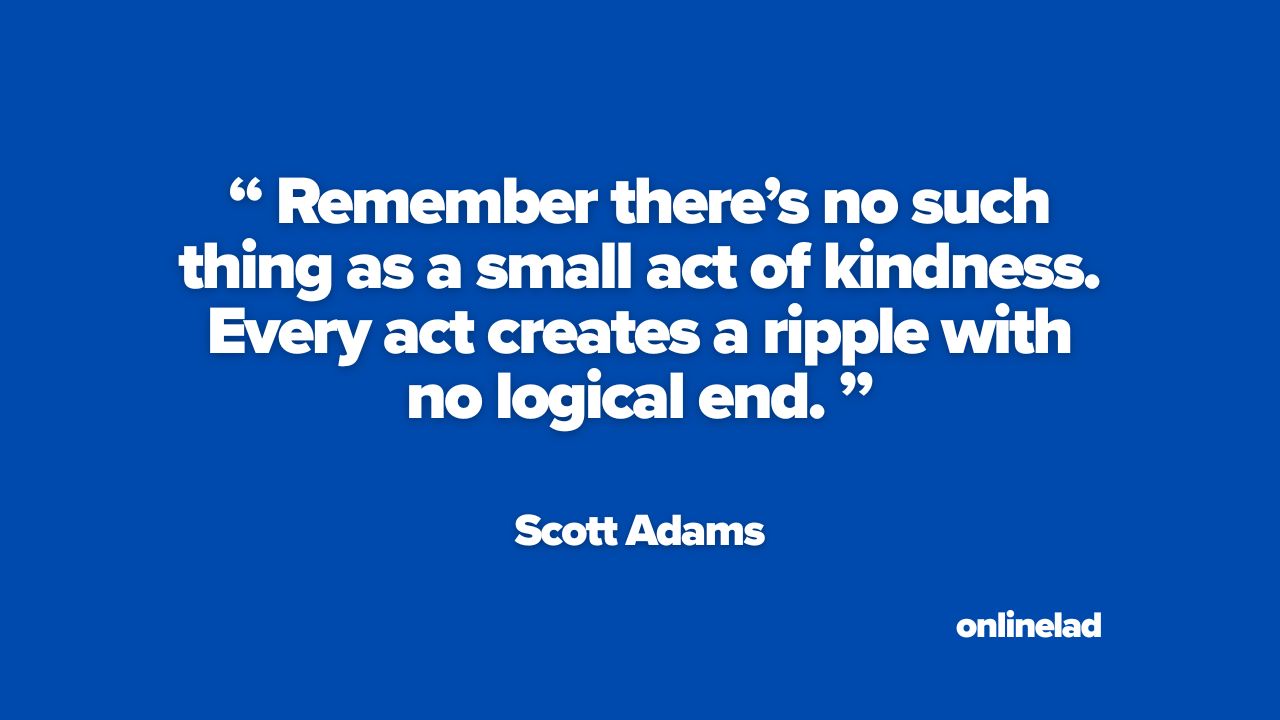
“Remember there’s no such thing as a small act of kindness. Every act creates a ripple with no logical end.” Those words from Scott Adams strike with unusual clarity in a world that often measures value by volume, speed, and visibility. We are conditioned to believe that impact must be loud to matter. Grand gestures trend. Outrage spreads. Success is quantified in followers, revenue, and status. Yet kindness, by contrast, often moves silently.
And that is precisely why this quote resonates so deeply in modern life. It challenges the assumption that only dramatic actions change the world. It reminds us that influence does not require an audience. It suggests that the smallest decision, a patient reply, a listening ear, a word of encouragement, may carry consequences far beyond what we can calculate.
In a culture of instant reactions and transactional relationships, kindness can feel naïve or even weak. Many people guard themselves. They withhold warmth to avoid vulnerability. They prioritise efficiency over empathy. But beneath that guarded exterior, most of us are quietly longing for something else. We want to be seen. We want to be understood. We want to feel that we matter.
This quote invites us to reconsider the scale of our daily behaviour. It asks a simple but powerful question: what if nothing we do is ever truly insignificant? What if the smallest act sets something in motion that continues long after we have forgotten it? That idea carries both responsibility and hope. Because if every act creates a ripple, then every one of us holds more influence than we realise.
Quote in Context
Scott Adams is widely known as the creator of the comic strip Dilbert, a series that satirises corporate culture and human behaviour. While much of his public work focuses on irony and observation, this quote reveals a more reflective dimension. It steps away from cynicism and points toward something fundamentally human: interconnectedness.
The metaphor of the ripple is ancient. Drop a stone into water and the disturbance spreads outward in expanding circles. You cannot control where the waves travel. You cannot predict which edge of the pond they will reach. Adams applies that image to human interaction. A kind word, a supportive action, a moment of patience, once released into the world, does not simply disappear. It travels through other people’s choices, moods, and decisions.
Consider how often your own behaviour has been shaped by someone else’s seemingly minor gesture. A teacher who believed in you. A stranger who showed unexpected respect. A friend who listened when you were close to giving up. Those moments rarely make headlines, yet they alter trajectories. They influence confidence. They restore dignity. They encourage risk-taking in positive ways.
What makes this quote powerful is that it frames kindness not as sentimentality but as cause and effect. It removes the illusion of isolation. We do not operate in sealed environments. Every interaction feeds into a larger system of relationships, workplaces, families, and communities. In that sense, kindness is not soft. It is structural. It shapes culture, often invisibly.
Finding the Deeper Meaning
At its core, this quote speaks to agency. It tells us that our daily choices matter more than we think. Many people feel powerless in modern life. They feel dwarfed by global events, economic pressures, and social comparison. When influence is measured by wealth or fame, the average person can feel irrelevant. But the ripple effect reframes power. It suggests that significance is not reserved for the extraordinary. It is embedded in the ordinary.
There is also a psychological truth here. Human beings are highly responsive to emotional cues. Kindness reduces defensiveness. It increases trust. It lowers stress responses. A single moment of understanding can change the emotional climate of an entire conversation. That shift can alter decisions, which then alter outcomes. The ripple is not mystical. It is behavioural.
For men especially, in a culture still negotiating the meaning of modern masculinity, this quote offers a quiet correction. Strength is often confused with dominance or emotional distance. Yet real confidence does not need to prove itself through hardness. A man secure in his identity can afford to be kind. He understands that composure, generosity, and patience are not weaknesses but indicators of inner stability.
Kindness also reinforces self-worth. When you act with integrity and empathy, you align behaviour with values. That alignment builds quiet confidence. You no longer rely solely on external validation because your actions reflect who you choose to be. The ripple moves outward, but it also moves inward, shaping your own identity.
Perhaps the most hopeful element of the quote is its emphasis on “no logical end.” We often hesitate to act kindly because we cannot see immediate results. We want proof. We want feedback. Yet the absence of visible reward does not mean absence of impact. The ripple continues beyond our line of sight. And that means every day presents an opportunity to influence the world in ways we may never fully witness.
In that sense, there are no small acts. There are only starting points.
Relevance to Modern Life
It is easy to underestimate kindness in an age defined by visibility. Algorithms reward controversy. Performance is often mistaken for authenticity. In professional settings, productivity tends to overshadow presence. Yet beneath the surface of modern life, relationships still determine almost everything that matters. Careers advance through trust. Partnerships survive through patience. Friendships deepen through consistency. And all of those foundations are shaped by small, repeated acts.
In relationships, the ripple effect is particularly clear. A thoughtful message when someone is overwhelmed. Choosing to listen rather than defend. Offering appreciation without being prompted. These gestures may feel minor in the moment, yet they accumulate. Over time, they build emotional safety. Emotional safety builds honesty. Honesty builds intimacy. What begins as something small becomes structural.
At work, the same principle applies. A leader who takes time to acknowledge effort rather than only results shapes a culture of loyalty. A colleague who shares credit rather than hoards it subtly alters the atmosphere of a team. Even in competitive environments, respect and fairness create influence that outlasts short-term wins. People remember how you made them feel long after they forget what you achieved.
On a personal level, kindness also intersects with confidence. Many people are guarded because they fear being taken advantage of or appearing weak. But genuine self-assurance does not need to operate from scarcity. When you know who you are, you do not treat every interaction as a negotiation. You can afford generosity. That posture changes how others respond to you. It changes how you see yourself.
The ripple effect also applies inwardly. The way you speak to yourself matters. A moment of self-compassion after a mistake can prevent a spiral of self-criticism. That pause may influence the next decision you make, which influences the next opportunity you take. In that sense, kindness is not just interpersonal. It is intrapersonal. It shapes the tone of your own life.
Modern life can feel transactional and rushed. This quote invites a slower, more deliberate standard. It suggests that influence is not measured only in milestones but in moments.
Applying the Message Personally
There are seasons when progress feels stalled. When ambition feels heavier than motivation. When you question whether your effort is being noticed. In those moments, it is tempting to withdraw or harden. To conserve energy. To stop extending yourself. Yet this is precisely where the ripple effect becomes personal.
You do not always control outcomes. You do control posture. You control how you respond when someone disappoints you. You control whether you add tension to a room or ease it. You control whether your standards include respect even when others fall short.
Overthinking often paralyses action because we want certainty. We want proof that what we do will matter. But kindness rarely offers immediate validation. Its influence is subtle. That subtlety can feel unsatisfying to an ambitious mind. Still, consistency in small actions builds identity. If you repeatedly choose patience, you become patient. If you repeatedly choose generosity, you become generous. That identity shift quietly alters the direction of your life.
When doubt creeps in, ask yourself a simpler question than “Will this change everything?” Instead ask, “Is this aligned with the man I want to be?” That reframing removes the pressure of scale. It focuses on character. Character compounds over time in the same way small acts do.
This week, choose one deliberate act of kindness that requires no recognition. It could be checking in on someone you have not spoken to in a while. It could be offering calm leadership in a tense conversation. It could even be granting yourself grace for a mistake you are still replaying. Do it without announcing it. Observe how it shifts your internal state. That is the ripple beginning.
Conclusion: The Power in the Unseen
Scott Adams’ words remind us that scale is often deceptive. The world does not only change through dramatic events. It changes through countless quiet decisions made by ordinary people who choose integrity over indifference.
There may be no immediate applause for kindness. No metrics. No guarantees. But there is continuity. A gesture given today may shape a conversation tomorrow. That conversation may influence a decision next month. That decision may alter a life in ways you never witness.
When you recognise that reality, your daily conduct takes on new weight. Not heavy in a burdensome sense, but meaningful. Every interaction becomes an opportunity to reinforce who you are and what you stand for.
Remember there is no such thing as a small act of kindness. Every act creates a ripple with no logical end.
And perhaps the most empowering truth is this: you never know how far yours has already travelled.