
Introduction: When the Noise Settles, Truth Emerges
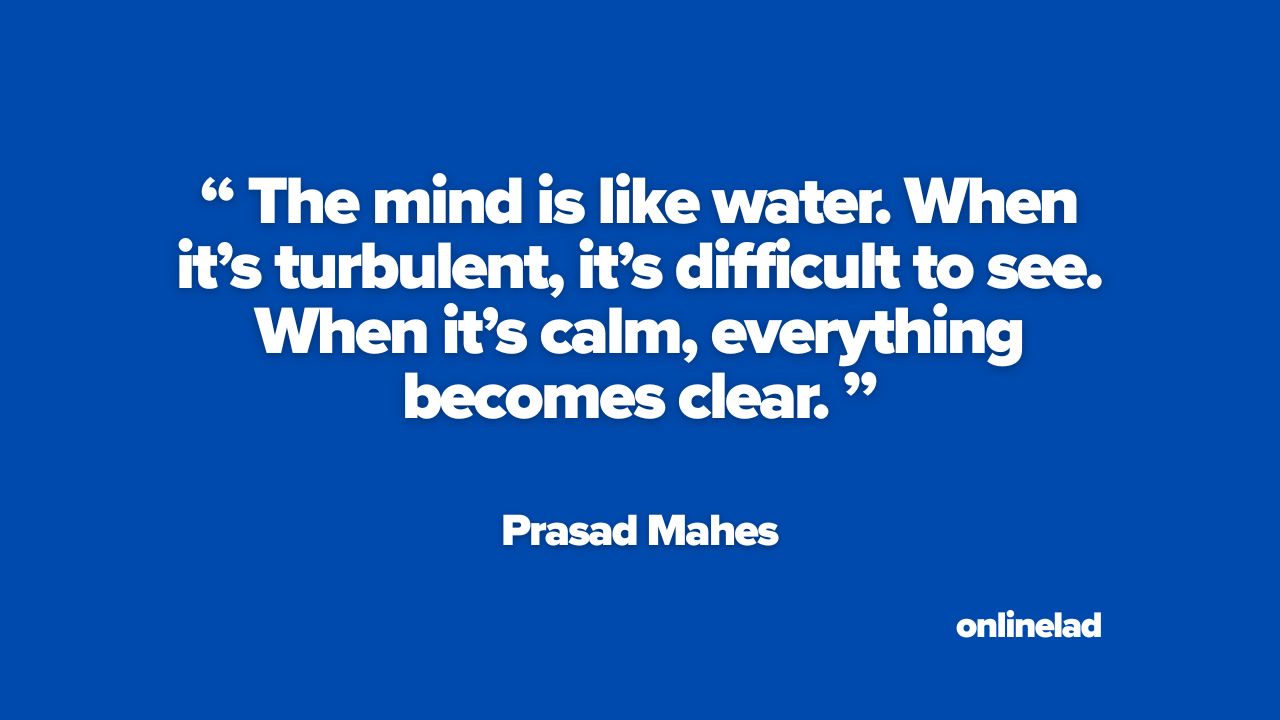
“The mind is like water. When it’s turbulent, it’s difficult to see. When it’s calm, everything becomes clear.” These words from Prasad Mahes land with quiet authority in a world that rarely slows down. We live in an age of constant input, endless scrolling, and pressure to react instantly to everything. Our thoughts mirror that chaos. They swirl, collide, and distort what is actually in front of us.
And yet, deep down, most people recognise the feeling Mahes describes. That moment when everything feels overwhelming, when decisions become harder, when even simple problems seem complicated. It is not always the situation itself that is unclear. It is the state of the mind trying to interpret it.
This quote resonates because it does not offer a complex solution. It points to something far more fundamental. Clarity is not something we chase externally. It is something that emerges when we remove internal noise. The more frantic the mind becomes, the less we see. The calmer it becomes, the more obvious things appear.
There is something grounding in that idea. It suggests that control does not come from forcing answers, but from creating the conditions where answers reveal themselves. In a culture that celebrates urgency and constant movement, this feels almost rebellious. To pause. To settle. To allow stillness.
Because perhaps the problem is not that life is confusing. Perhaps it is that we are trying to understand it while standing in the middle of a storm.
Quote in Context
Prasad Mahes is known for sharing reflective insights that draw from timeless philosophical ideas, particularly those rooted in mindfulness and self-awareness. His comparison of the mind to water echoes principles found in ancient traditions such as Buddhism and Taoism, where clarity is often linked to stillness rather than effort.
The imagery itself is simple, but powerful. Water, when disturbed, becomes opaque. It distorts reflections, hides what lies beneath, and makes even shallow depths appear uncertain. But when left undisturbed, it settles naturally. The surface becomes smooth. What was hidden becomes visible without force.
This metaphor has endured across cultures because it reflects something universally human. We all experience moments where emotion clouds judgement. Anger, stress, anxiety, and even excitement can create turbulence within the mind. In those moments, perception becomes unreliable. We misread situations, overthink outcomes, and often act in ways we later question.
Mahes’ quote matters because it reframes how we approach these states. It does not suggest suppressing emotion or striving for constant calm. Instead, it highlights awareness. Recognising that a turbulent mind cannot see clearly is, in itself, a powerful shift. It allows space between reaction and response.
In modern life, where decisions are often made quickly and under pressure, this perspective becomes even more relevant. The ability to pause, to recognise internal turbulence, and to wait for clarity is not weakness. It is discipline. It is control.
What Mahes offers is not just a poetic observation. It is a practical lens through which to understand how we think, how we react, and ultimately, how we navigate the world.
Finding the Deeper Meaning
At its core, this quote speaks to the relationship between inner state and external reality. It reminds us that what we see is often shaped by how we feel. A restless mind does not just process information differently. It distorts it. It amplifies fears, magnifies problems, and creates narratives that may not exist.
When the mind is turbulent, everything feels urgent. Every decision carries weight. Every uncertainty feels like a threat. This is where many people live without realising it. Constantly reacting, constantly analysing, but rarely stepping back. The result is mental exhaustion and a sense of being stuck, even when the path forward is simple.
Calm, on the other hand, is not about doing less. It is about seeing more clearly. When the mind settles, priorities become obvious. Decisions feel lighter because they are no longer clouded by noise. You begin to respond instead of react. You gain perspective instead of becoming consumed by the moment.
This has profound implications for confidence and self-belief. True confidence is not loud or impulsive. It is steady. It comes from clarity. When you understand your thoughts, when you are not overwhelmed by them, you move differently. You trust your judgement. You act with intention.
In a world that often pushes people towards constant stimulation and distraction, cultivating calm becomes a form of strength. It requires patience. It requires discipline. It means resisting the urge to fill every silence and reacting to every trigger.
But the reward is powerful. Because when the mind becomes still, even briefly, you begin to see things as they are. And in that clarity, the next step often reveals itself without force.
Relevance to Modern Life
In modern life, mental turbulence has almost become the default setting. Notifications, deadlines, expectations, and comparison all compete for attention, often leaving little space to think clearly. It is not just that people are busy. It is that they are constantly stimulated. The result is a mind that rarely settles, and when it does not settle, it struggles to see what truly matters.
In relationships, this shows up as overthinking. A delayed reply becomes a source of doubt. A small misunderstanding turns into a larger narrative. When the mind is unsettled, it fills in gaps with assumptions rather than clarity. What could have been resolved with calm communication becomes complicated by internal noise.
At work, the same pattern emerges. Pressure and urgency can create a sense that everything must be decided immediately. People rush decisions, second-guess themselves, or feel overwhelmed by options. It is not always a lack of ability that causes confusion. Often, it is a lack of mental stillness. When the mind is crowded, even simple tasks feel heavy.
Confidence, too, is deeply tied to this idea. Many assume confidence is about certainty or boldness, but more often it is about clarity. When you are calm, you understand your position. You know what you stand for. You are less reactive to external opinions because your internal state is steady. Turbulence, on the other hand, makes you question everything. It creates doubt where there was none.
Even in personal standards and direction, the quote holds weight. People often feel lost, not because they lack direction, but because they are trying to find it while mentally overwhelmed. The more noise there is, the harder it becomes to distinguish between what you want and what you think you should want.
Mahes’ words cut through all of this. They remind us that clarity is not found by adding more information or forcing answers. It is found by reducing internal noise. In a world that encourages constant movement, the ability to be still, even briefly, becomes a quiet advantage.
Applying the Message Personally
There are moments everyone recognises. Sitting with a decision that feels heavier than it should. Replaying conversations. Questioning whether you are on the right path. These are not always signs that something is wrong. More often, they are signs that the mind is unsettled.
It is easy to respond by doing more. Seeking more advice, consuming more content, trying to think harder. But this often adds to the turbulence rather than resolving it. The quote invites a different approach. Instead of pushing for clarity, it suggests creating the conditions where clarity can appear.
This starts with awareness. Recognising when your thoughts are being driven by stress, emotion, or external pressure. In those moments, the goal is not to solve everything immediately. It is to pause. To step back, even briefly, and allow the mind to settle.
This does not require anything complicated. It could be as simple as taking a walk without distractions, sitting quietly for a few minutes, or removing yourself from a situation before responding. What matters is the intention. You are not avoiding the issue. You are giving yourself the space to see it clearly.
When the mind calms, something shifts. The same situation often looks different. What felt overwhelming becomes manageable. What felt confusing becomes more defined. You begin to trust your judgement again because it is no longer clouded by noise.
If there is one practical takeaway to carry into this week, it is this. When you feel overwhelmed or unsure, do not force a decision in that moment. Instead, create space. Step away, even briefly, and return to it once your mind has settled. It is a small shift, but it changes how you approach everything from conversations to life decisions.
Clarity is rarely found in the middle of chaos. It reveals itself when you allow things to quiet down.
Conclusion: Stillness Is Where Truth Lives
There is a quiet strength in understanding that not every moment requires immediate action. In a world that often rewards speed and reaction, choosing stillness can feel counterintuitive. Yet it is in that stillness where perspective returns, where emotions settle, and where clarity begins to form.
Prasad Mahes’ words remind us that the mind is not something to fight against, but something to understand. Turbulence will come. Stress, pressure, and uncertainty are part of life. But they do not have to dictate how we see the world or how we respond to it.
When you recognise that a restless mind cannot see clearly, you give yourself permission to pause. That pause is not weakness. It is awareness. It is control. It is the space between reaction and intention.
Over time, this becomes more than a momentary practice. It becomes a way of moving through life. You begin to notice when your thoughts are clouded. You become less attached to immediate answers and more focused on clear ones. You trust that clarity will come, not by force, but by allowing the mind to settle.
And when it does, things often feel simpler than they first appeared. Decisions align more naturally. Conversations become more grounded. Confidence becomes quieter, but stronger.
Perhaps that is the real message behind the quote. Not that life becomes easier when the mind is calm, but that it becomes clearer. And with clarity, everything else follows.
“The mind is like water. When it’s turbulent, it’s difficult to see. When it’s calm, everything becomes clear.”