
Introduction: The Small Acts That Shape Everything
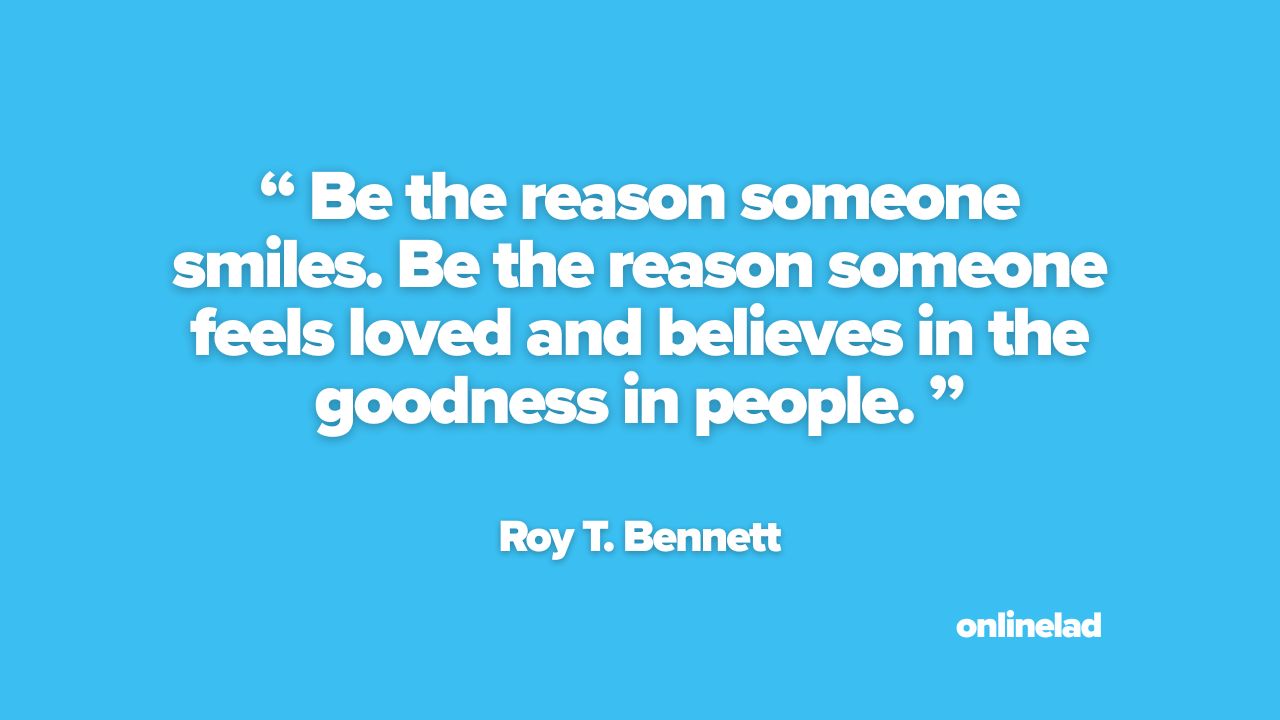
“Be the reason someone smiles. Be the reason someone feels loved and believes in the goodness in people.” These words from Roy T. Bennett land softly, yet carry a quiet authority that feels increasingly rare in a fast-moving, often disconnected world.
In an age defined by speed, comparison, and constant noise, it is easy to underestimate the power of something as simple as kindness. We are encouraged to chase milestones, build identities, and prove our worth. Yet beneath all of that, what people remember most are the moments where they felt seen, valued, and genuinely cared for.
This quote resonates because it reminds us of something we already know, but often forget. That our presence in someone else’s life, however brief, can shift their entire day. A kind word, a thoughtful gesture, or even a moment of patience can become a turning point for someone who needed it more than we realised.
At its core, this is not about grand gestures or performative goodness. It is about intention. It is about choosing, in small and consistent ways, to contribute something positive to the world around us. That choice has a ripple effect far beyond what we can see.
As explored throughout onlinelad, the most meaningful forms of confidence and strength often come from how we treat others, not just how we present ourselves. This quote invites us to look beyond our own ambitions and consider the impact we leave behind in everyday moments.
Quote in Context
Roy T. Bennett, the author of this quote, is known for his reflections on personal growth, kindness, and self-awareness. His writing often centres on the idea that character is revealed not through status or success, but through everyday actions and choices. This particular quote reflects a broader philosophy that places human connection at the heart of a meaningful life.
While many modern narratives focus on individual achievement, Bennett’s perspective shifts the lens. He reminds us that our influence is not limited to what we accomplish, but extends to how we make others feel. In a culture where interactions can often feel transactional, this idea carries weight. It challenges the assumption that success is purely personal, and instead frames it as something relational.
The quote also taps into a universal human need. Everyone, regardless of background or ambition, wants to feel valued and understood. The ability to contribute to that feeling in someone else is both powerful and deeply human. It is not reserved for specific moments or relationships. It exists in everyday interactions, from a passing conversation to a meaningful connection.
In many ways, this message feels even more relevant today. With digital communication often replacing face-to-face interaction, genuine warmth can feel diluted. Yet it is precisely in this environment that authenticity stands out. A sincere gesture or kind word can cut through the noise and remind someone that there is still goodness in the world.
Bennett’s words are not simply aspirational. They are practical. They encourage a shift in perspective, from asking “What can I gain?” to “What can I give?” And in doing so, they redefine what it means to live with purpose.
Finding the Deeper Meaning
At a deeper level, this quote is not just about kindness. It is about responsibility. It suggests that each of us holds a subtle but significant influence over the emotional experiences of others. Whether we realise it or not, the way we speak, act, and respond can either reinforce someone’s belief in people or quietly diminish it.
This idea connects closely to self-awareness. To be the reason someone smiles requires presence. It requires noticing others, reading the room, and choosing empathy over indifference. In a world where many are preoccupied with their own pressures, this level of awareness can feel rare. Yet it is precisely this rarity that makes it so impactful.
There is also a deeper link to confidence. True confidence is not loud or self-centred. It is grounded. It allows space for others. When someone feels secure in themselves, they are far more likely to lift others up rather than compete with them. In this way, kindness becomes a reflection of inner strength rather than weakness.
Emotionally, the quote speaks to the human desire for connection. People carry unseen struggles. A single moment of kindness can act as reassurance that they are not alone. It can restore faith, even if only briefly, that there is still good in the world. That belief can be powerful enough to change how someone approaches their day, their relationships, or even themselves.
Ultimately, the message is simple but profound. You may never fully see the impact of your actions, but that does not make them insignificant. In fact, it makes them more important. Because the smallest acts, done consistently and without expectation, often leave the deepest and most lasting impression.
Relevance to Modern Life
It is easy to assume that a quote about kindness belongs to a simpler time, but in reality, its relevance has only grown stronger. Modern life is fast, transactional, and often emotionally distant. People are more connected than ever through technology, yet many feel increasingly unseen in their day-to-day lives. In that environment, being the reason someone smiles is not just a pleasant idea, it becomes something quietly powerful.
In relationships, this message shifts the focus away from keeping score. It is not about who did more or who gave more, but about how consistently you contribute to the emotional tone of the connection. A thoughtful message, genuine listening, or even patience during difficult moments can build trust in ways that grand gestures cannot. Over time, these small acts become the foundation of something stable and meaningful.
At work, the same principle applies. Professional environments often reward performance, output, and efficiency. Yet the people who leave a lasting impression are not always the loudest or most outwardly successful. They are often the ones who bring calm, respect, and encouragement into the room. The colleague who acknowledges effort, the manager who takes time to understand, or the individual who chooses not to escalate tension all contribute to a healthier, more human workplace.
On a personal level, this idea also ties into how we carry ourselves. Confidence is often misunderstood as dominance or visibility. In reality, it is more closely linked to consistency and intention. Choosing to treat others well, even when it is not required or recognised, reflects a strong internal standard. It shows that your behaviour is not dictated by mood or circumstance, but by who you have decided to be.
Perhaps most importantly, this quote reminds us that influence does not require a platform. You do not need a large audience or a significant moment to make an impact. Everyday interactions, the ones that feel small or forgettable, are often where this kind of influence lives. And in a world that can feel increasingly impersonal, those moments matter more than we tend to realise.
Applying the Message Personally
There are moments in life where it is easy to become inwardly focused. Periods of doubt, uncertainty, or overthinking can narrow your perspective until everything revolves around your own concerns. During those times, the idea of being the reason someone else smiles can feel distant or even secondary. Yet it is often in these exact moments that the message becomes most valuable.
Choosing to show kindness does not require you to have everything figured out. It does not demand that you feel confident, successful, or completely in control. In fact, it can work in the opposite direction. When you step outside of your own internal noise, even briefly, and contribute something positive to someone else’s experience, it can create a sense of clarity. It reminds you that your presence has value beyond your own self-assessment.
There is also something grounding about focusing on what you can give rather than what you lack. When you are caught in cycles of comparison or self-doubt, your attention is often fixed on perceived gaps. Shifting that attention outward, even in small ways, breaks that pattern. It brings you back to something simple and real. A conversation, a moment of support, or a quiet act of consideration.
This does not mean ignoring your own needs or pretending everything is fine. It means recognising that your actions still carry weight, regardless of how you feel internally. You can still choose to be patient, to listen properly, or to respond with care. Over time, these choices shape both how others experience you and how you begin to see yourself.
Actionable takeaway: This week, choose one interaction each day where you consciously decide to improve someone else’s experience. It does not need to be dramatic. It could be a genuine compliment, giving someone your full attention without distraction, or simply responding with more patience than usual. Observe how it changes not only their reaction, but your own mindset as well.
Conclusion: The Impact You Leave Behind
When you return to Roy T. Bennett’s words, their strength lies in their simplicity. “Be the reason someone smiles. Be the reason someone feels loved and believes in the goodness in people.” It is not a complex philosophy, yet it touches something fundamental about how we exist alongside others.
In a world that often encourages self-focus, this message offers a quiet alternative. It does not ask you to diminish your ambitions or ignore your own path. Instead, it invites you to consider the impact you leave as you move through it. Not just what you achieve, but how you make people feel along the way.
There is a calm confidence in living like this. It removes the need for constant validation or recognition, because the value of your actions is not dependent on being seen. It exists in the effect they have, even when that effect is invisible to you. Over time, those small, consistent choices form a kind of personal legacy, one built not on attention, but on intention.
Perhaps the most reassuring part of this idea is that it is always available. No matter where you are in life, no matter how uncertain things feel, you still have the ability to contribute something positive to someone else’s day. That ability does not require perfection. It only requires awareness and a willingness to act on it.
And if that perspective resonates, it is worth surrounding yourself with more of it. You can join onlinelad to explore further reflections like this, each one designed to bring a little more clarity, confidence, and calm into everyday life.
Because sometimes, the most meaningful thing you can do is simple. Be the reason someone believes there is still good in people.