
Introduction: The Quiet Truth We Spend a Lifetime Avoiding
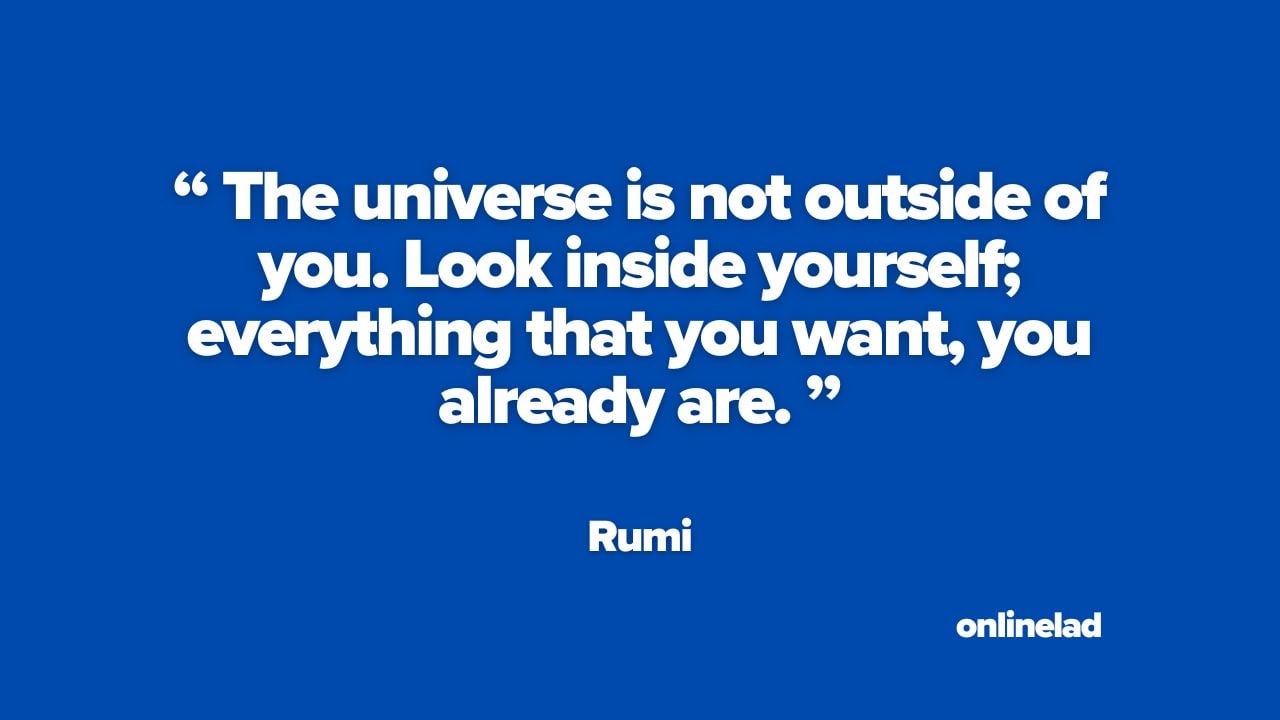
“The universe is not outside of you. Look inside yourself; everything that you want, you already are.” These words, attributed to the 13th-century poet and mystic Rumi, carry a weight that feels both comforting and confronting. In a world that constantly tells us to look outward for answers, validation, and success, this quote gently but firmly redirects our attention inward.
Modern life is built on pursuit. We chase careers, relationships, status, and experiences, often believing that fulfilment lives just beyond the next milestone. Social media amplifies this feeling, presenting curated versions of other people’s lives that make us question whether we are doing enough, being enough, or becoming enough. Yet Rumi’s words challenge that entire framework. They suggest that what we seek is not missing, but overlooked.
This idea resonates now more than ever because so many people feel disconnected despite being more connected than at any other point in history. There is a quiet exhaustion that comes from constantly searching. And beneath it, a deeper question begins to surface: what if the answer isn’t out there at all?
At its core, this quote invites a shift in perspective. It is not about abandoning ambition or desire, but about redefining where they begin. The journey is not one of acquisition, but of recognition. For readers exploring themes of identity, growth, and self-belief on onlinelad, this message lands with a rare clarity. It suggests that the person you are becoming is not something you need to build from scratch, but something you need to uncover.
Quote in Context
Rumi, born in 1207 in what is now Afghanistan, remains one of the most widely read poets in the world. His work transcends time, culture, and religion, largely because it speaks to universal human experiences: love, longing, identity, and the search for meaning. As a Sufi mystic, Rumi’s teachings often centred on the idea that the divine is not separate from us, but exists within us.
This quote reflects that philosophy. Rather than positioning the universe as something vast and external, Rumi reframes it as something intimate and internal. It is a radical shift, especially when viewed through a modern lens. Today, we are conditioned to believe that success, happiness, and fulfilment are things to be earned or acquired. Rumi suggests the opposite. He implies that these qualities are already present within us, waiting to be recognised and expressed.
Historically, Sufi teachings encouraged inward reflection as a path to understanding both the self and the world. The idea was simple but profound: by knowing yourself deeply, you come to understand everything else. This was not about ego or self-importance, but about awareness. It was about stripping away distractions, expectations, and external noise to uncover something more authentic.
What makes this quote endure is its relevance across generations. Whether someone is navigating career uncertainty, relationship struggles, or questions of purpose, the message remains the same. The answers are not hidden in distant places or future achievements. They exist in the present, within the individual. Rumi’s words are not offering a quick solution, but a different way of seeing. And in that shift of perspective lies their power.
Finding the Deeper Meaning
At first glance, the idea that “everything that you want, you already are” can feel almost too simple. But beneath that simplicity lies a challenging truth. It requires a level of honesty and self-awareness that many people spend years avoiding. To accept this idea is to acknowledge that the qualities we admire in others—confidence, strength, creativity, resilience—are not exclusive traits, but reflections of something already within us.
The difficulty is not in becoming these things, but in believing that we can. Modern life has a way of disconnecting people from their own sense of worth. External validation becomes the benchmark, and self-doubt quietly takes root. We begin to measure ourselves against unrealistic standards, forgetting that growth is not about comparison, but about alignment.
Rumi’s message encourages a return to that alignment. It asks us to look inward, not as a retreat from the world, but as a foundation for engaging with it more authentically. Confidence, for example, is often seen as something to build over time. But what if it is less about building and more about uncovering? What if it already exists beneath layers of fear, conditioning, and expectation?
This perspective also reframes ambition. Instead of chasing something external, ambition becomes an expression of who you already are. It is no longer about proving your worth, but about living in a way that reflects it. That shift can be transformative. It removes the pressure to constantly seek approval and replaces it with a quieter, more sustainable form of self-belief.
Ultimately, this quote is not about instant clarity or easy answers. It is about a process. A gradual turning inward. A willingness to sit with discomfort, question assumptions, and recognise that the version of yourself you are searching for has been there all along. The universe, as Rumi suggests, is not something you need to find. It is something you need to realise.
Relevance to Modern Life
It is easy to read Rumi’s words and appreciate their beauty, but their real power lies in how they challenge the way we live today. Modern life is built on external markers. Success is often measured by job titles, income, social recognition, or the perception of progress. Even in relationships, there can be a quiet pressure to find someone who completes us, as though we are arriving incomplete. Against this backdrop, the idea that “everything that you want, you already are” feels almost disruptive.
In practical terms, this quote speaks directly to the tension many people carry without fully articulating. At work, it shows up as imposter syndrome. You achieve something, yet still feel as though you do not belong. In relationships, it appears as insecurity or the need for reassurance. In personal goals, it becomes a cycle of starting and stopping, driven by doubt rather than direction. What Rumi’s message offers is not a denial of these experiences, but a reframing of them.
If the qualities you are seeking already exist within you, then the issue is not absence, but access. Confidence, for example, is often treated as something that arrives after success. In reality, it tends to grow when you begin acting in alignment with who you already are, even before you feel ready. The same applies to clarity. People wait for certainty before making decisions, yet clarity often follows action, not the other way around.
This perspective also reshapes how we view comparison. In a culture where it is easy to measure your life against someone else’s highlights, it becomes tempting to believe that they possess something you lack. Rumi’s words quietly dismantle that belief. They suggest that what you recognise and admire in others is often a reflection of something within yourself that has not yet been fully expressed.
Ultimately, the relevance of this quote lies in its simplicity. It does not ask you to become someone else or chase something distant. It asks you to pause, to look inward, and to question whether the gap you feel is real or simply perceived. In a world that constantly pushes you outward, that inward shift is both rare and necessary.
Applying the Message Personally
Understanding this idea intellectually is one thing. Living it, even in small ways, is another. The challenge is not in agreeing with Rumi’s words, but in trusting them enough to act differently. Most people experience moments of doubt on a daily basis. A hesitation before speaking up. A second-guessing of a decision. A quiet voice that questions whether you are capable or ready. These moments often pass unnoticed, yet they shape the direction of your life more than any single major decision.
Applying this message begins with recognising those moments for what they are. Not evidence that you are lacking something, but opportunities to reconnect with what is already there. Instead of asking, “Am I good enough for this?” the question becomes, “What would this look like if I trusted myself?” That shift is subtle, but it changes the way you move through situations.
In practice, this might mean taking action before you feel completely certain. It might mean setting boundaries in a relationship because you recognise your own worth, rather than waiting for someone else to validate it. It could be as simple as allowing yourself to pursue something you have been putting off, not because you are suddenly fearless, but because you accept that fear does not define your capability.
There is also an element of patience involved. Looking inward is not a quick process. It requires a willingness to sit with discomfort and to question long-held assumptions about yourself. But over time, it creates a different kind of stability. One that is not dependent on outcomes or external approval.
A simple takeaway for this week: notice one moment each day where you instinctively doubt yourself, and choose to act as though that doubt is not the final authority. You do not need to eliminate the feeling. You only need to stop letting it decide for you.
That is where this quote becomes practical. Not in grand gestures, but in small, consistent shifts. The more you act from a place of internal recognition rather than external validation, the more natural it begins to feel. And over time, you realise that you were never trying to become someone new. You were simply learning to trust who you already are.
Conclusion: Coming Back to Yourself
There is something quietly grounding about returning to the idea that nothing essential is missing. In a world that constantly encourages more, faster, and better, Rumi’s words offer a different kind of reassurance. They remind you that the search you are on may not be about finding something new, but about recognising something familiar.
Throughout life, it is easy to drift away from that understanding. Expectations build, comparisons creep in, and the noise of the outside world becomes difficult to ignore. Yet the core message remains unchanged. What you are looking for is not somewhere else. It is not waiting at the end of a perfect plan or a flawless execution. It exists within you, in quieter moments of clarity, in instincts you often overlook, and in the parts of yourself you are still learning to trust.
This does not mean the journey is effortless. There will still be uncertainty, setbacks, and questions without immediate answers. But there is a difference between moving forward while believing you are incomplete, and moving forward with the understanding that you are already whole. That difference shapes how you respond to challenges, how you approach opportunities, and how you see yourself in the process.
“The universe is not outside of you. Look inside yourself; everything that you want, you already are.” As a closing thought, it is less a statement to admire and more a perspective to return to. Especially in moments when you feel unsure or disconnected, it offers a simple reminder. You are not as far away from what you are seeking as you might think.
For those who want to continue exploring ideas like this and build a stronger connection with themselves over time, you can join onlinelad and become part of a space designed for thoughtful growth, reflection, and perspective.