
Introduction: A Different Foundation for Progress
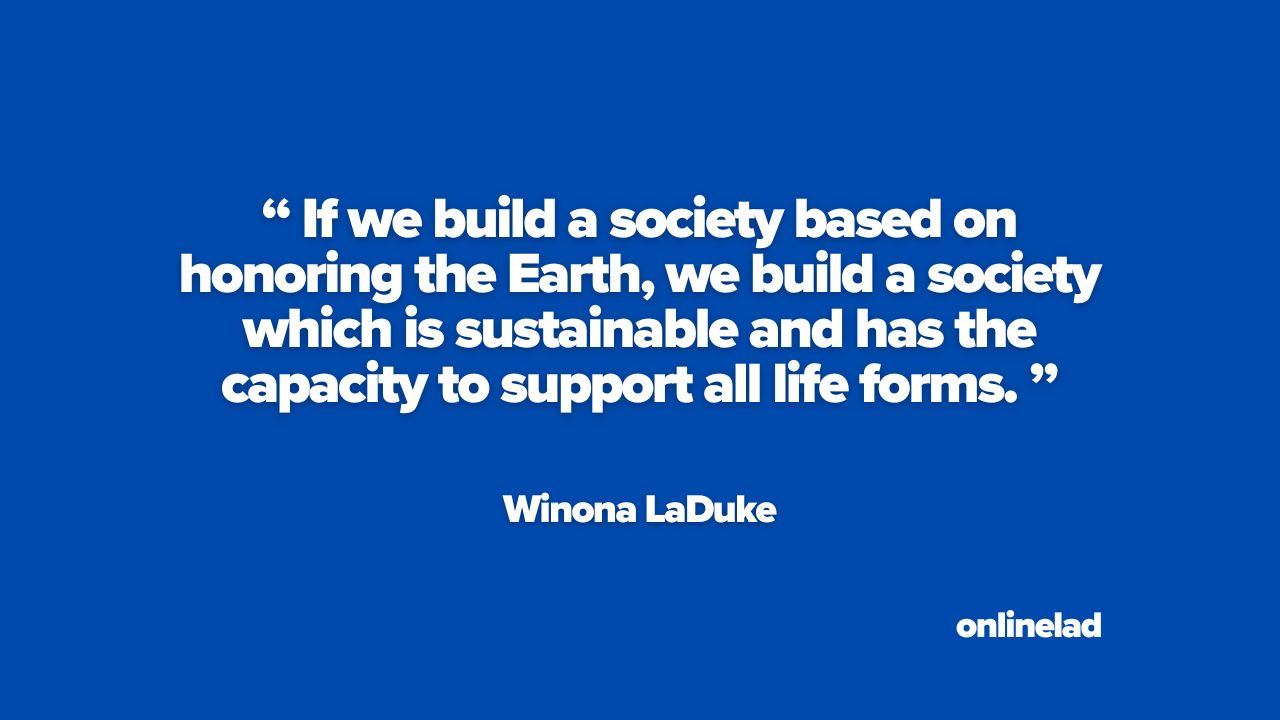
“If we build a society based on honoring the Earth, we build a society which is sustainable and has the capacity to support all life forms.” These words from Winona LaDuke arrive with quiet authority. They do not demand attention. They earn it.
In a world defined by speed, extraction, and short-term gain, the idea of honouring the Earth can feel almost radical. Yet it also feels instinctively correct. Beneath modern complexity, there remains a simple truth: we are not separate from the systems that sustain us.
The quote resonates today because it challenges the foundation of how societies measure success. Growth without regard for consequence is no longer sustainable. What once seemed like progress now reveals its limitations.
At onlinelad, we explore ideas that shape not just individuals, but the environments they exist within. This quote invites a shift in perspective. It asks not what we can take, but what we are willing to protect.
Quote in Context
Winona LaDuke is an environmental activist, economist, and member of the White Earth Band of Ojibwe. Her work has long centred on Indigenous knowledge systems, land stewardship, and sustainable development. This quote reflects a worldview rooted in respect rather than dominance.
For many Indigenous cultures, the Earth is not a resource. It is a relationship. Land is not owned. It is cared for. This distinction is subtle but profound. It changes how decisions are made, how communities are built, and how future generations are considered.
LaDuke’s message emerges from lived experience. It is not theoretical. It is shaped by the consequences of environmental neglect and the resilience of communities that have resisted it. Her words carry weight because they are grounded in both tradition and urgency.
In modern discourse, sustainability is often treated as a technical challenge. Better systems, cleaner energy, smarter policies. While these matter, LaDuke’s perspective goes deeper. It suggests that sustainability is ultimately a question of values.
Finding the Deeper Meaning
At its core, this quote is about alignment. A society that honours the Earth operates in harmony with its surroundings rather than in opposition to them. It recognises limits, respects balance, and values continuity over immediate reward.
There is also a moral dimension. To honour something is to treat it with care and intention. It implies responsibility. When applied to the Earth, it transforms environmental concern from an obligation into a principle.
This idea extends beyond ecology. It speaks to how individuals approach their own lives. The same mindset that leads to overconsumption externally often reflects imbalance internally. Discipline, restraint, and awareness are not just personal virtues. They are societal necessities.
The quote also introduces a broader definition of success. A society that supports all life forms is not measured solely by wealth or power. It is measured by its ability to sustain, protect, and coexist.
Relevance to Modern Life
Modern life often encourages disconnection. Food arrives without context. Energy is consumed without thought. Waste disappears without consequence. This distance makes it easy to overlook the impact of everyday choices.
LaDuke’s message challenges that detachment. It calls for awareness. Not in an abstract sense, but in practical, daily decisions. What we buy, how we travel, what we prioritise.
There is also a deeper relevance in how we approach ambition. Many people pursue success at the expense of sustainability, both personally and environmentally. Burnout, imbalance, and depletion are common outcomes.
Honouring the Earth mirrors the idea of honouring oneself. It requires pacing, awareness, and respect for limits. In this way, sustainability is not just an environmental principle. It is a lifestyle approach.
The quote becomes less about global systems and more about individual alignment. Each decision contributes to a larger pattern. Over time, those patterns define the world we live in.
Applying the Message Personally
Applying this idea does not require dramatic change. It begins with attention. Small, consistent actions often carry more weight than occasional grand gestures.
Start by observing your own habits. Where do you consume without thinking? Where do you take more than you need? These questions are not about guilt. They are about awareness.
From there, introduce intention. Choose quality over quantity. Support systems and businesses that align with sustainability. Reduce waste where possible. These actions may seem minor, but they compound over time.
There is also value in reconnecting with natural environments. Time spent outdoors recalibrates perspective. It reminds you of scale, rhythm, and balance. These experiences reinforce the mindset that LaDuke describes.
Weekly takeaway: Choose one area of your life where you can reduce excess and increase intention. Keep it simple, measurable, and consistent.
Conclusion: A Quiet Shift That Changes Everything
The strength of this quote lies in its simplicity. It does not offer a complex solution. It offers a clear direction. Honour the Earth, and everything else follows.
This idea reframes sustainability from a challenge into a choice. A choice about values, priorities, and long-term thinking. It suggests that the future is not something we wait for. It is something we actively shape.
There is a quiet confidence in this approach. It does not rely on urgency or fear. It relies on clarity. When we align with systems that sustain life, we naturally create environments that support growth.
In the end, the question is not whether we can afford to honour the Earth. It is whether we can afford not to.
If this perspective resonates, you can join onlinelad for more reflections grounded in clarity, purpose, and thoughtful growth.