
Introduction: Why Nature Still Steadies the Human Spirit
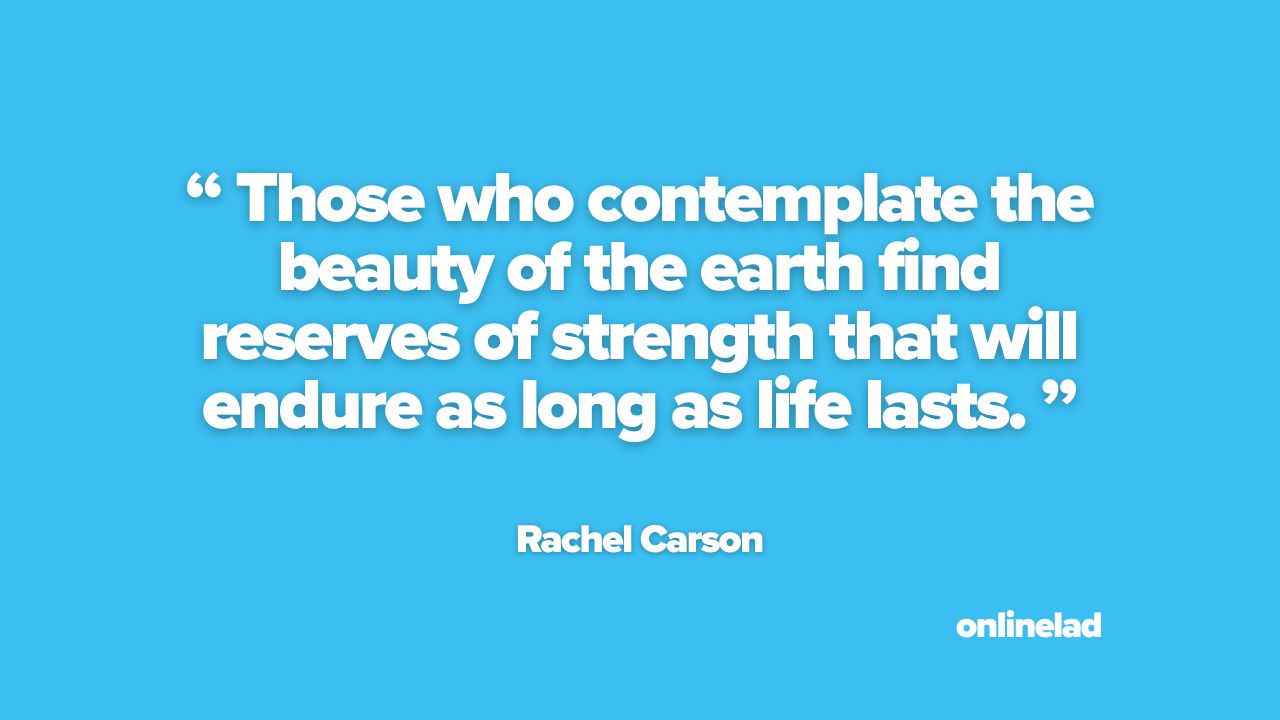
“Those who contemplate the beauty of the earth find reserves of strength that will endure as long as life lasts.” These words from Rachel Carson speak with a quiet authority that feels especially necessary today. Carson, the influential writer, marine biologist, and conservationist, understood nature not as decoration, but as a source of inner renewal.
Her quote reminds us that strength is not always found through force, ambition, or constant striving. Sometimes it arrives when we look closely at the world around us: the movement of trees, the rhythm of water, the patience of seasons, the detail of a single flower pushing through difficult ground.
In a culture that often rewards speed, distraction, and emotional hardness, Carson’s words invite a different kind of confidence. They suggest that beauty can become a form of endurance. To notice the earth is to remember that life is larger than our immediate worries.
At onlinelad, this kind of reflection matters because personal growth is not only about achievement. It is also about learning where to place your attention when life feels heavy.
Quote in Context
Rachel Carson’s work changed how many people understood the relationship between human life and the natural world. Best known for her environmental writing, she brought scientific seriousness and poetic sensitivity together in a way that made ecological concern deeply personal. She did not write about nature as something distant from human experience. She wrote about it as something intimately connected to health, conscience, wonder, and survival.
This quote matters because it reflects Carson’s belief that attention itself can be transformative. To contemplate the beauty of the earth is not passive. It is an active decision to look beyond noise, fear, and consumption. It is a way of grounding the mind in something older, wider, and more enduring than personal anxiety.
Carson lived in a time of expanding industrial confidence, when progress was often measured by control over the natural world. Her writing challenged that assumption with clarity and grace. She asked people to see the earth not as a resource to be exhausted, but as a living presence worthy of respect.
That is why this quote feels like lived wisdom rather than simple sentiment. Carson understood that beauty is not weak. It can strengthen attention, deepen humility, and give people the courage to continue. The earth, properly seen, becomes not an escape from life, but a reminder of how to live it.
Finding the Deeper Meaning
The deeper meaning of Carson’s quote lies in the relationship between beauty and resilience. She suggests that when we truly observe the earth, we gain access to strength that is not temporary or superficial. This is not the short burst of motivation that fades by evening. It is something quieter and more durable.
To contemplate beauty is to slow down enough to notice what remains steady. A coastline shaped by time, a tree that bends without breaking, a sky that changes without losing its vastness. These images speak to the human condition. They remind us that change, pressure, and uncertainty are not signs that life has failed. They are part of life’s structure.
There is also a lesson here about identity. Modern life can make people define themselves by productivity, appearance, status, or approval. Nature refuses that narrow measurement. It shows value without performance. A mountain does not need applause. A river does not ask permission to move forward.
That is why Carson’s words carry emotional weight. They invite us to draw confidence from something beyond ego. The strength she describes is not loud. It is rooted. It comes from paying attention to the world with reverence, and discovering that our own lives are part of a much larger pattern.
Relevance to Modern Life
In modern life, many people are mentally crowded. Work demands attention. Relationships require emotional maturity. Social media invites comparison. News cycles create unease. Even rest can begin to feel like another task to optimise. In this climate, Carson’s quote offers a necessary correction.
She reminds us that the human mind needs contact with beauty, not as luxury, but as nourishment. A walk without headphones, a few minutes beside water, a morning sky noticed before emails begin. These moments may seem small, yet they restore something essential. They return us to proportion.
When life becomes intense, problems can feel total. A difficult conversation, professional disappointment, or period of self-doubt can dominate the whole inner landscape. Nature interrupts that narrowing. It does not remove responsibility, but it changes the scale. It reminds us that we are not only our stress, our work, our mistakes, or our waiting.
This is especially relevant in relationships and personal growth. A grounded person is not someone untouched by difficulty. A grounded person has practices that help them return to themselves. Carson’s message encourages that return through attention, beauty, and humility.
In a restless world, the ability to notice the earth becomes a quiet form of discipline. It teaches patience. It softens panic. It strengthens perspective.
Applying the Message Personally
To apply Carson’s message personally, begin with attention. Not grand gestures. Not dramatic reinvention. Simply choose to notice the natural world with more seriousness. Look at the sky before reaching for your phone. Take a walk without turning it into a fitness target. Sit near a window and observe the weather without needing it to be different.
This practice matters because overthinking often thrives in enclosed mental spaces. When the mind circles the same fear, doubt, or hesitation, it can begin to mistake repetition for truth. Nature offers a way out of that loop. It gives the senses something honest to meet.
There is also a practical confidence in this. When you regularly place yourself near things that are steady, alive, and unconcerned with approval, you begin to absorb a different rhythm. You become less ruled by urgency. You remember that growth takes seasons. You learn that strength can be patient.
The weekly takeaway is clear: spend one deliberate hour this week in nature without distraction. No scrolling. No multitasking. Walk, sit, observe, and let the world become larger than your thoughts.
This is not avoidance. It is restoration. Carson’s quote asks us to understand beauty as a serious force, one capable of helping us endure what life asks of us.
Conclusion: The Quiet Strength That Lasts
Rachel Carson’s words endure because they speak to something many people feel but rarely name. The earth strengthens us when we remember how to see it. Its beauty does not deny pain, pressure, or uncertainty. Instead, it gives us a place to stand within them.
“Those who contemplate the beauty of the earth find reserves of strength that will endure as long as life lasts.” The quote is not asking us to romanticise life. It is asking us to pay attention. To look closely enough at the world that we recover perspective, humility, and courage.
In the end, Carson’s message is simple but profound. Strength is not always built by pushing harder. Sometimes it is found by becoming still enough to receive what has been around us all along.
For more reflections on confidence, resilience, and grounded personal growth, join onlinelad.