
Introduction: The Quiet Discipline of Seeing Clearly
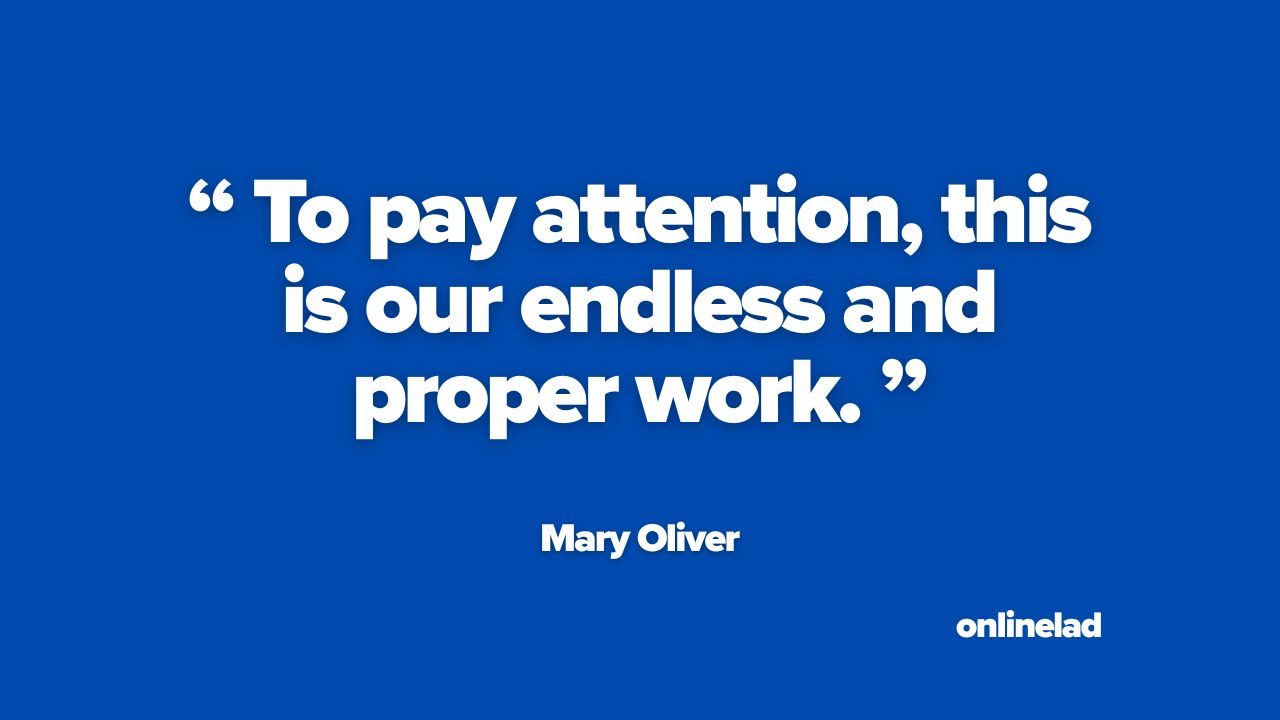
“To pay attention, this is our endless and proper work.” These words from Mary Oliver hold the kind of stillness that becomes more powerful the longer we sit with it. Oliver, one of the most cherished poets of the natural world, understood attention not as a passing habit, but as a way of living. To her, noticing was not passive. It was an act of devotion, discipline, humility, and care.
In a world built to interrupt us, the quote feels especially alive today. Our minds are pulled between screens, obligations, anxieties, ambitions, and the constant pressure to respond. We are often encouraged to move faster, achieve more, and keep pace with everything around us. Yet Oliver points towards something quieter and more demanding: the responsibility to actually see our lives while we are living them.
This is why her words continue to resonate with thoughtful readers. Attention is not merely about focus. It is about presence. It is about learning how to recognise what matters before it disappears into the noise. At onlinelad, ideas like this speak to the deeper work of confidence, self-worth, and personal growth. They remind us that a meaningful life is not always built by chasing more, but by becoming more awake to what is already here.
Quote in Context
Mary Oliver’s work was shaped by close observation. Her poetry often moved through woods, ponds, birds, flowers, light, weather, and the ordinary details most people pass without noticing. But she was never simply writing about nature as scenery. For Oliver, the natural world became a place of moral and emotional instruction. It taught patience, awareness, mortality, wonder, and belonging.
When she writes, “To pay attention, this is our endless and proper work,” she is not offering a light suggestion. She is identifying attention as a lifelong responsibility. The word “endless” matters. It implies that attention is not something we master once and keep forever. It is something we return to, again and again, because distraction, fear, ego, and habit are always waiting to pull us away.
The word “proper” matters too. Oliver suggests that paying attention is not a luxury reserved for artists, poets, or people with quiet lives. It is appropriate to all of us. It is part of what it means to live well. To notice another person’s pain, to listen without rushing, to observe our own thoughts honestly, to recognise beauty without needing to possess it, these are not small acts. They are forms of maturity.
Her quote is lived wisdom because it comes from a life spent looking closely. Oliver did not turn attention into an abstract virtue. She practised it through language, solitude, walking, and noticing the world in its fragile detail. That is what gives the quote its authority. It is not a performance of wisdom. It is the evidence of a life deeply observed.
Finding the Deeper Meaning
At its deepest level, Oliver’s quote asks us to reconsider what real work is. Modern life often defines work as output, achievement, productivity, or visible progress. Yet Oliver points towards an inner work that is less visible but perhaps more essential. Paying attention means refusing to sleepwalk through our own existence.
Attention shapes identity. What we repeatedly notice becomes part of who we are. If we only notice threats, comparisons, failures, and what we lack, our inner world becomes narrow and defensive. If we learn to notice beauty, effort, sincerity, courage, and small moments of truth, our sense of life begins to widen. Attention is not neutral. It trains the self.
There is also resilience in this message. To pay attention is to stay present with life as it is, not only as we wish it to be. That requires courage. It is easier to avoid discomfort, rush past grief, or distract ourselves from uncertainty. But a grounded person learns to look directly at experience without being destroyed by it. This is where confidence becomes quiet and real. It is not the loud belief that nothing can touch us. It is the steadier knowledge that we can remain awake, even when life is difficult.
Discipline also lives inside the quote. Attention is a practice. It asks us to return from distraction, to listen more carefully, to choose depth over noise. Oliver’s words remind us that a meaningful life is not only made through grand decisions. It is shaped by the quality of our awareness in ordinary moments.
Relevance to Modern Life
Mary Oliver’s words feel increasingly relevant because attention has become one of the most contested parts of modern life. Every day, people are invited to scatter themselves. Notifications, opinions, news cycles, comparison, work demands, and social media all compete for the mind. The result is not only distraction. It is emotional exhaustion.
In relationships, attention is often the difference between being physically present and genuinely present. Many people are heard, but not really listened to. They are seen, but not truly noticed. Oliver’s quote reminds us that love, friendship, and trust depend on attention. To pay attention to someone is to tell them, without grand speeches, that they matter.
In work and ambition, attention is equally important. Progress requires the ability to notice patterns, weaknesses, opportunities, and the difference between meaningful effort and restless activity. A distracted person may be busy for years without becoming clearer. A person who pays attention begins to understand where their energy is going, what their standards are, and whether their daily actions match the life they claim to want.
The quote also speaks to self-direction. Many people feel lost not because they lack intelligence or potential, but because they have not stopped long enough to listen to themselves honestly. They know what they are expected to want, but not always what they truly value. Attention creates that opening. It allows us to notice when we are living by fear, approval, habit, or genuine conviction.
Oliver’s message is not an escape from modern life. It is a way to move through it with more integrity. We cannot remove every distraction, but we can become more deliberate about what we allow to shape us.
Applying the Message Personally
To apply Mary Oliver’s message personally, begin by treating attention as a daily practice rather than a personality trait. Some people assume they are simply distracted by nature, but attention can be strengthened. It grows through repetition, environment, and choice. The first step is often noticing where your attention currently goes.
Pay attention to what drains you. Pay attention to the conversations that leave you feeling smaller. Pay attention to the habits you defend even though they cost you peace. Pay attention to the moments when you feel most honest, most alive, most yourself. These observations can reveal more than any dramatic reinvention.
Doubt and overthinking often grow in the absence of clear attention. When the mind is scattered, every decision feels heavier. We imagine too many futures, replay too many mistakes, and confuse movement with progress. Oliver’s wisdom invites us back to the present fact. What is happening now? What do I know to be true? What is asking for care, courage, or correction?
One clear weekly takeaway is this: choose one ordinary moment each day and give it your full attention for five uninterrupted minutes. It could be a walk, a meal, a conversation, a cup of coffee, or a quiet moment before work. Do not optimise it. Do not document it. Simply notice. The light, the mood, the body, the breath, the person in front of you, the thoughts moving through your mind.
This may sound small, but it is not. A life changes when attention changes. What we notice, we begin to understand. What we understand, we can choose more wisely.
Conclusion: The Work That Brings Us Back to Life
Mary Oliver’s quote brings us back to a simple but demanding truth: life is not only something to be achieved. It is something to be noticed. “To pay attention, this is our endless and proper work” is a reminder that presence is not a soft idea. It is a serious practice. It asks for discipline, honesty, patience, and reverence.
In paying attention, we become less available to noise and more available to meaning. We begin to see the people around us with greater care. We recognise our own patterns with more honesty. We notice beauty without rushing past it. We become more capable of choosing the life we are actually living, rather than drifting through one shaped entirely by pressure and distraction.
Oliver’s wisdom does not demand perfection. It asks for return. Return to the moment. Return to what matters. Return to the world before it becomes invisible. That return is endless because life keeps unfolding. It is proper because nothing meaningful can be built without first learning how to see.
For more reflective writing on confidence, self-worth, discipline, and personal growth, you can join onlinelad and continue exploring the ideas that shape a more deliberate life.