
Introduction: The Quiet Truth Hidden Inside Care
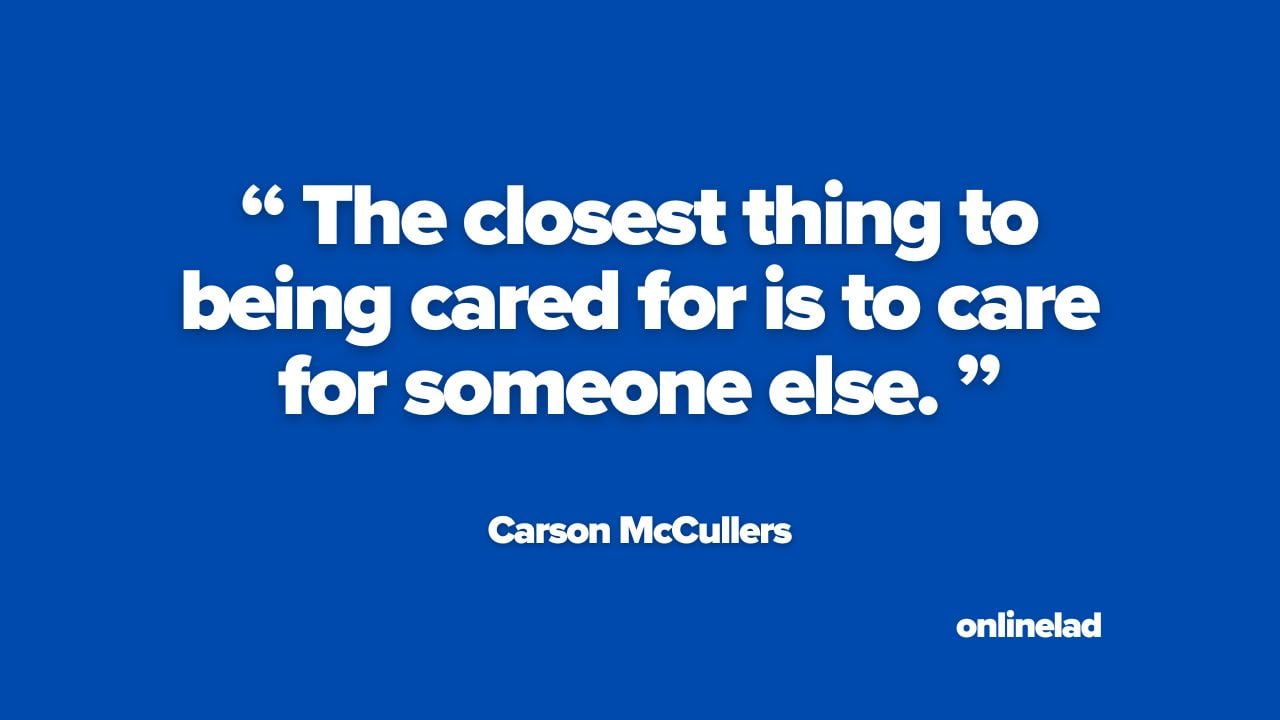
“The closest thing to being cared for is to care for someone else.” These words, attributed to Carson McCullers, hold a kind of emotional precision that does not need to shout. They speak to one of the most private aches of human life: the desire to feel seen, protected, remembered, and held in another person’s concern. Yet the quote does not offer a simple promise that caring for others will erase loneliness. It suggests something subtler, and perhaps more honest. When care is absent, uncertain, or difficult to receive, the act of extending care can bring us near to the feeling we long for.
That is why the line still resonates today. In a world of constant communication, many people still feel emotionally untouched. They are surrounded by messages, notifications, opinions, and performances, yet starved of genuine tenderness. McCullers gives language to that contradiction with rare calmness. To care for someone else is not merely an act of kindness. It is a way of entering the human circle again.
At onlinelad, quotes like this matter because they invite us to examine confidence and self-worth beneath the surface. The question is not only whether we are loved. It is whether we are willing to remain loving, even when life has made us guarded.
Quote in Context
Carson McCullers was a writer deeply attuned to loneliness, longing, difference, and the fragile ways people seek connection. Her work often explored characters who were emotionally isolated, misunderstood, or quietly desperate to belong. This quote fits naturally within that world. It does not romanticise suffering. It recognises that care is one of the central currencies of human life, and that the absence of it can shape a person profoundly.
What makes the line powerful is its lack of sentimentality. McCullers does not say that caring for someone else is the same as being cared for. She says it is the closest thing. That distinction matters. It respects the reality that receiving love and giving love are not identical experiences. A person can be generous and still lonely. A person can support others and still need support themselves. But the act of caring can bring warmth into a place that might otherwise remain cold.
In that sense, the quote reads like lived wisdom rather than abstract philosophy. It feels as though it comes from someone who understood emotional hunger from the inside. To care for another person is to move beyond the prison of the self, even temporarily. It gives shape to feeling. It turns longing into action. It allows a person to participate in the tenderness they may not always receive.
That is why this quote continues to carry weight. It understands both the beauty and the ache of being human.
Finding the Deeper Meaning
The deeper meaning of McCullers’ words lies in the relationship between need and generosity. Many people assume that care must first be received before it can be given. In an ideal world, perhaps that would be true. We would all be securely loved, emotionally nourished, and naturally able to offer tenderness from a place of abundance. Real life is more complicated. Often, people learn care through absence. They understand its value precisely because they know what it feels like to go without it.
This quote does not encourage self-abandonment. It is not a call to pour endlessly into others while ignoring one’s own emotional needs. Instead, it points towards the dignity of choosing care as an expression of identity. To care for someone else is to say, quietly and without performance, that pain has not made you cruel. Disappointment has not made you indifferent. Loneliness has not closed your heart completely.
There is resilience in that. There is discipline too. Caring well often requires patience, attention, humility, and emotional steadiness. It asks us to listen rather than dominate, to notice rather than assume, and to remain present when withdrawal would be easier.
Confidence is often misunderstood as self-containment, as though the strongest people need no one. McCullers suggests something more mature. The strong person is not the one who feels nothing. The strong person is the one who can still offer care without pretending they have no needs of their own.
Relevance to Modern Life
Modern life makes care both easier to signal and harder to practise. We can send quick messages, react to updates, and appear involved in the lives of others with minimal effort. Yet genuine care requires more than digital presence. It requires attention. It requires memory. It requires the willingness to be inconvenienced by another person’s reality.
That is why McCullers’ quote feels especially relevant now. Many people are exhausted by shallow connection. They may have hundreds of contacts but few people they would call in a difficult hour. They may be admired professionally but feel unseen personally. They may give the impression of being fine while carrying private emotional weight.
In work, relationships, friendships, and family life, the act of caring can become a grounding force. It pulls us away from constant self-analysis and into meaningful participation. When we check on someone properly, when we remember what matters to them, when we offer patience instead of judgement, we recover a sense of human usefulness.
There is also a lesson here for ambition. A life built only around achievement can become emotionally thin. Success may bring status, but care brings depth. The people who live well are not only those who accumulate victories, but those who remain capable of tenderness while pursuing them.
To care for someone else is not an escape from one’s own life. It is a way of making that life more human.
Applying the Message Personally
Applying this quote personally begins with honesty. Ask where you are waiting to be cared for, and where that waiting has turned into bitterness, withdrawal, or emotional hesitation. Most people have places within them that feel neglected. The danger is not the need itself. The danger is allowing unmet need to harden into indifference.
One practical response is to choose care deliberately, not dramatically. Care does not always need grand gestures. It may look like sending the message you keep postponing, listening without turning the conversation back to yourself, giving someone your full attention, or noticing when a person’s tone has changed. It may mean being consistent rather than intense.
This matters because overthinking often blocks care. We hesitate because we fear seeming needy, intrusive, foolish, or sentimental. We wait for the perfect wording, the perfect time, the perfect emotional certainty. Meanwhile, the opportunity to be kind quietly passes. McCullers’ quote reminds us that care becomes real only when it leaves the realm of feeling and enters behaviour.
The weekly takeaway is simple: choose one person this week and care for them with intention. Do not make it about being praised, needed, or recognised. Ask a thoughtful question. Remember a detail. Offer help without making them earn it. Then notice what happens inside you when care becomes action.
You may not receive exactly what you hoped for in return. But you may feel closer to the tenderness you thought was missing.
Conclusion: Remaining Open in a Guarded World
Carson McCullers’ quote endures because it speaks to a truth many people feel but rarely admit. To be cared for is one of the deepest human needs. When that need is unmet, we can become guarded, cynical, or quietly resentful. Yet McCullers offers another possibility. We can move towards care by becoming caring ourselves.
“The closest thing to being cared for is to care for someone else” is not a denial of our need to be loved. It is an invitation to remain emotionally alive. It reminds us that care is not only something we receive from the world. It is something we practise within it.
There is strength in that practice. There is self-respect in refusing to let absence define the whole of your character. To care is to keep faith with the best part of yourself, even when life has not always been gentle.
For more reflective writing on confidence, self-worth, discipline, relationships, and personal growth, you can join onlinelad and continue exploring the ideas that shape a more grounded life.