
Introduction: Strength Reveals Itself in How We Treat People
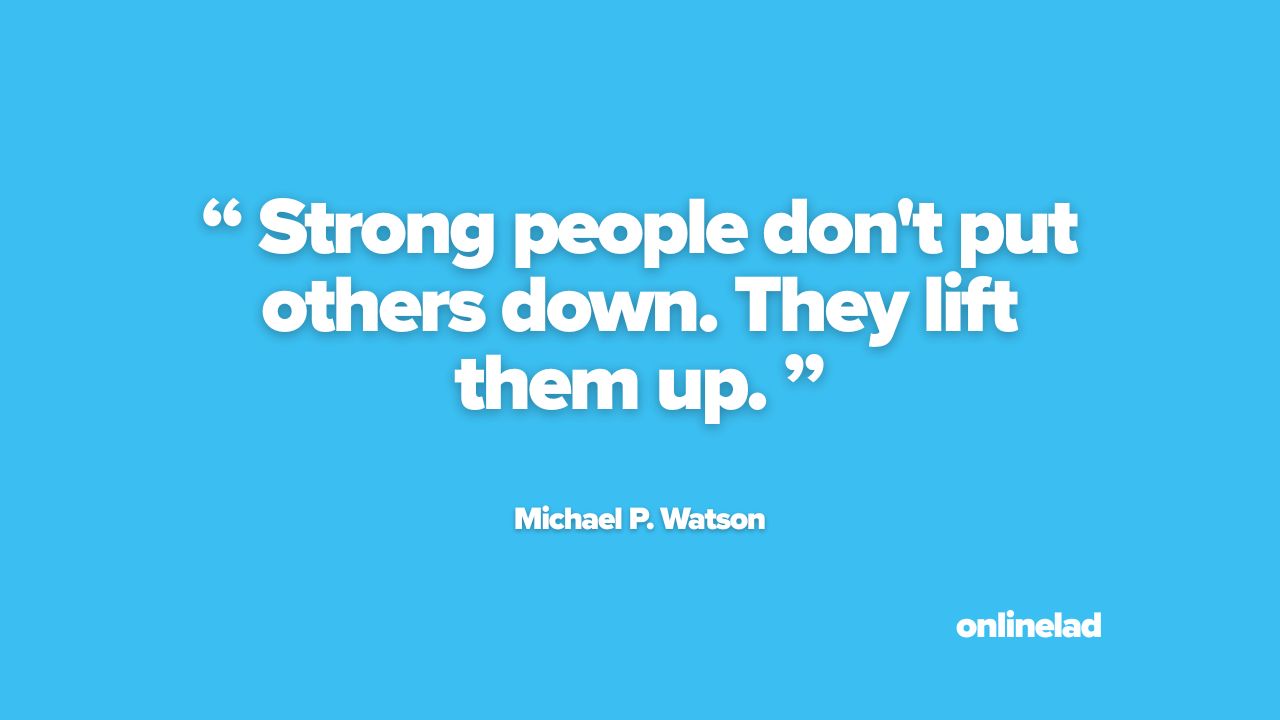
“Strong people don’t put others down. They lift them up.” This observation, attributed to Michael P. Watson, offers a simple but demanding definition of strength. It asks us to look beyond confidence as performance and consider how genuine confidence affects the people around us.
Many people learn to associate strength with dominance. The loudest voice appears powerful. The sharpest criticism sounds intelligent. The person who always wins the argument seems secure. Yet these behaviours can just as easily come from insecurity, fear or a need to control how others see us. Real strength rarely needs another person to become smaller.
That is why the quote continues to resonate. Modern life encourages comparison at almost every turn. Careers, relationships, appearance, wealth and status are constantly measured against somebody else’s progress. In that environment, supporting another person can feel strangely courageous. It requires enough self-belief to recognise that someone else’s success does not diminish our own.
The idea also reflects something central to the values explored by onlinelad: character is not only revealed by what we achieve, but by the atmosphere we create around us. Strength becomes meaningful when it gives other people room to stand taller.
Quote in Context
The line is commonly attributed to Michael P. Watson and has circulated widely as a reflection on kindness, confidence and personal character. Its enduring appeal lies less in a complicated philosophical argument than in the clarity of its contrast. People can use their influence to diminish others, or they can use it to encourage them.
That choice appears in ordinary moments. It is present when a manager responds to a mistake, when a friend shares good news, when a partner expresses uncertainty or when someone less experienced asks for help. In each situation, strength can become either a weapon or a source of stability.
Putting someone down may create a temporary feeling of superiority. It can win attention, establish control or protect an insecure ego. But it does not produce genuine authority. Respect built through humiliation is usually fragile. People may comply, but they rarely feel loyalty, trust or admiration.
Lifting someone up does not mean offering empty praise or avoiding difficult truths. It can involve honest feedback, firm boundaries and direct conversations. The difference lies in intention. Constructive honesty helps a person see more clearly and move forward. Cruelty uses the truth, or a distorted version of it, to make someone feel inadequate.
This is why the quote belongs among the motivational quotes selected by onlinelad that deserve more than a passing glance. It expresses lived wisdom about the responsible use of confidence. The strongest person in a room is often not the one demanding recognition. It is the one whose presence allows others to feel capable, respected and safe enough to contribute.
Finding the Deeper Meaning
At its deepest level, the quote challenges the belief that human worth is competitive. When identity depends on being better than somebody else, another person’s intelligence, beauty, confidence or success can feel threatening. Criticism then becomes a form of self-protection. By lowering another person, we try to restore our own position.
Secure people do not need that arrangement. Their confidence is grounded in an internal sense of worth rather than a constantly changing social ranking. They can admire another person without feeling erased. They can offer praise without fearing that recognition is a limited resource.
This kind of strength also requires emotional discipline. Envy, irritation and defensiveness are normal human responses. Strength is not the absence of these feelings. It is the ability to notice them without allowing them to govern our behaviour. A strong person may feel threatened, but still choose fairness. They may feel disappointed, but still refuse to humiliate someone.
There is resilience in this approach. People who have faced difficulty often understand how significant a well-timed word of encouragement can be. They know that dignity matters most when someone is struggling. Rather than using another person’s vulnerable moment to establish superiority, they offer perspective, patience or practical support.
The quote therefore presents strength as relational. Confidence is not only something we possess privately. It becomes visible through our effect on others. Do people become guarded around us, or do they feel able to speak honestly? Do we leave them questioning their value, or better able to recognise it? Our answers reveal more about our inner stability than any display of toughness ever could.
Relevance to Modern Life
Modern culture makes this message particularly relevant. Social media often rewards mockery, outrage and public correction. A cutting response can attract more attention than a thoughtful one. People are encouraged to turn disagreement into entertainment and another person’s mistake into evidence of their complete inadequacy.
The workplace presents a quieter version of the same pressure. Ambitious people may believe they must guard information, take excessive credit or expose a colleague’s weakness to secure their own position. Yet healthy professional influence usually develops through the opposite behaviour. People remember the colleague who shared knowledge, acknowledged contributions and remained composed when something went wrong.
The principle matters just as much in close relationships. Partners sometimes use private insecurities against one another during conflict. Friends may disguise resentment as humour. Family members can repeat dismissive patterns for years because nobody challenges them. These habits slowly erode trust, even when each individual comment appears insignificant.
Lifting people up does not require constant agreement. Mature relationships depend on the ability to challenge each other. But challenge can preserve dignity. We can question a decision without attacking someone’s intelligence. We can express hurt without trying to create shame. We can leave a relationship without rewriting the other person as entirely worthless.
There is also a personal cost to repeatedly putting people down. Cynicism may look sophisticated, but living in constant judgement narrows our world. We begin to search for weakness everywhere, including within ourselves. Encouragement creates a different mental habit. It trains us to recognise effort, possibility and growth without becoming naïve about flaws. In a culture built around comparison, helping another person feel stronger is an act of both generosity and self-direction.
Applying the Message Personally
Applying this message begins with observing the small ways we respond to other people. Consider what happens internally when someone receives praise, reaches a goal or displays a quality you wish you possessed. Do you become genuinely pleased, quietly withdrawn or tempted to point out a flaw? The answer is not a reason for shame. It is useful information about where your confidence may need attention.
Before criticising someone, ask what you are trying to achieve. Are you helping them improve, protecting a reasonable boundary or simply releasing your own frustration? The same words can have very different effects depending on the intention and tone behind them.
It is also worth examining humour. Teasing can create closeness when trust is strong and both people feel included. It becomes damaging when one person is consistently made into the target, particularly after they have shown discomfort. Strength means being willing to adjust rather than insisting that another person is too sensitive.
Lifting others can be practical. Mention a colleague’s contribution when it might otherwise be overlooked. Tell a friend precisely what you admire about the way they handled a difficult period. Give advice without making the other person feel foolish for needing it. Speak well of people when they are not present.
When doubt or overthinking prevents you from offering encouragement, remember that sincerity matters more than perfect wording. A simple acknowledgement can stay with someone for years.
Your weekly takeaway is clear: choose one person each day and offer a specific, honest form of encouragement. Avoid vague praise. Name the quality, effort or decision you respect. At the end of the week, notice not only how they responded, but how the practice affected your own sense of confidence and connection.
Conclusion: The Quiet Confidence That Makes Others Stronger
“Strong people don’t put others down. They lift them up” remains powerful because it turns strength from an image into a responsibility. It reminds us that confidence should not merely help us occupy more space. It should improve the way that space feels for everyone around us.
There will always be situations that require firmness. Some people need to be challenged. Certain relationships need stronger boundaries, and not every disagreement can be softened into harmony. But dignity and strength are not opposites. We can be clear without becoming cruel, ambitious without becoming threatened and honest without using truth as a means of humiliation.
The most secure people tend to make encouragement feel natural. They do not treat praise as a loss of status. They understand that another person’s growth can exist alongside their own. Their influence is felt not because they demand admiration, but because people leave their company with greater clarity and self-respect.
That standard is worth carrying into work, friendship, love and private conversation. Our strength is revealed in what we build within other people as much as in what we achieve for ourselves. To explore more thoughtful ideas about confidence, discipline and personal growth, join onlinelad.