
Introduction: The Quiet Power of Living What You Believe
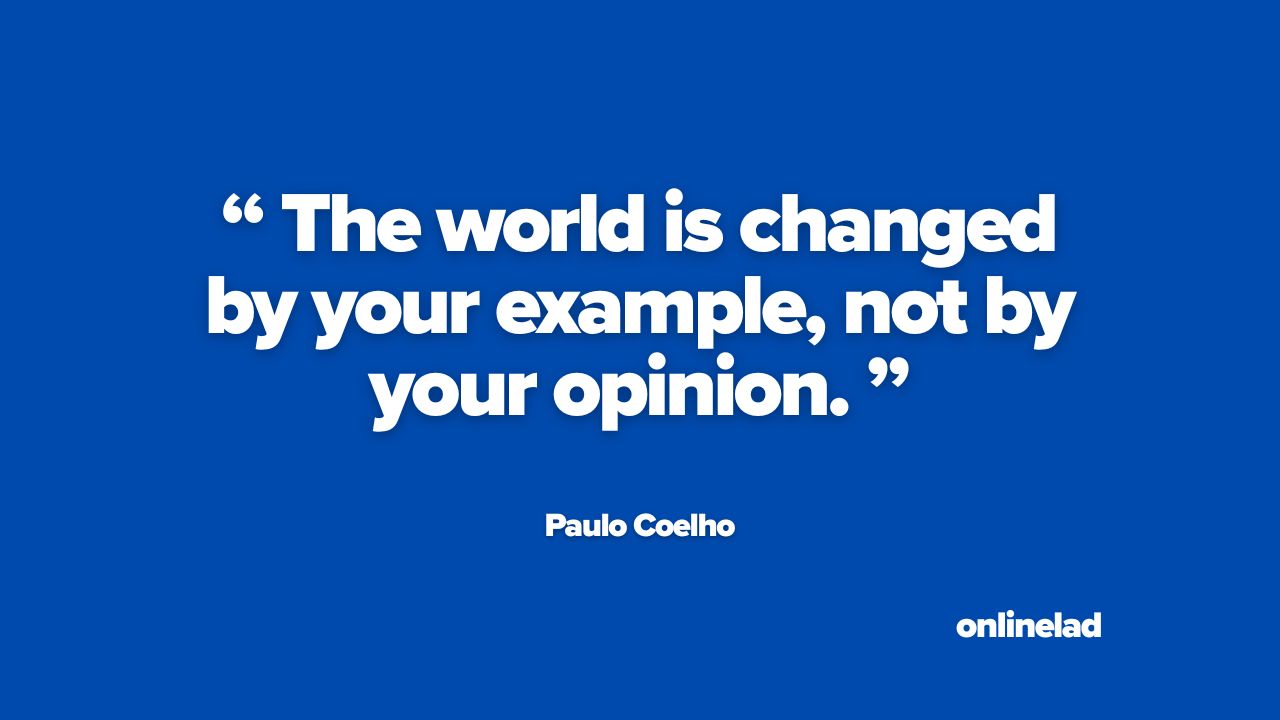
“The world is changed by your example, not by your opinion.” These words, attributed to Paulo Coelho, carry a particular weight in a time when opinion is everywhere. We live surrounded by commentary, reactions, declarations and endless statements of belief. Yet beneath all that noise, most people are still asking the same quiet question: who can I trust?
Coelho’s quote speaks to that question with uncommon clarity. It reminds us that influence is not built through volume, certainty or the ability to win arguments. It is built through conduct. People may listen to what we say, but they study how we live. They notice how we handle pressure, how we treat others, how we respond when things do not go our way, and whether our private choices match our public values.
This is why the quote resonates so deeply today. In a culture that often rewards visibility, it brings us back to substance. It suggests that real change begins not with performance, but with personal alignment. For readers of onlinelad, it is a powerful reminder that confidence, discipline and self-worth are not just ideas to discuss. They are qualities to practise, quietly and consistently, until they become visible through the life we lead.
Quote in Context
Paulo Coelho is widely known for writing about purpose, courage, spiritual searching and the inner life of human beings. His work often explores the tension between what people say they want and what they are willing to become in pursuit of it. This quote sits naturally within that wider philosophy. It points towards the idea that wisdom is only meaningful when it is embodied.
Opinions are easy to form. They require thought, but not necessarily sacrifice. Example is different. Example asks something of us. It asks for patience when impatience would be easier. It asks for discipline when distraction is more comfortable. It asks for integrity when nobody is watching. That is why example carries more authority than opinion. It has been tested by action.
The quote matters because it challenges a common human habit: the belief that being right is the same as being useful. Many people spend energy trying to persuade others, correct others or prove a point. Yet the people who genuinely shift the atmosphere around them often do so without constant explanation. Their life becomes the argument. Their steadiness becomes the proof.
Seen this way, Coelho’s words are not a rejection of speech or conviction. Opinions can matter. Ideas can shape culture. But words without lived evidence become fragile. They may sound convincing for a moment, but they do not create lasting trust. Lived wisdom does. The person who practises what they believe becomes difficult to dismiss, because their example has already spoken before they have.
Finding the Deeper Meaning
At its deepest level, this quote is about alignment. It asks us to look at the distance between what we claim and what we demonstrate. That distance can be uncomfortable to examine, but it is also where growth begins. The world does not need perfect people. It needs people who are honest enough to close the gap between their values and their behaviour.
There is also a lesson here about identity. Many people build their identity around what they think, what they oppose or what they intend to do. But identity becomes stronger when it is grounded in repeated action. A disciplined person is not simply someone who admires discipline. A confident person is not simply someone who talks about confidence. A resilient person is not someone who has avoided difficulty, but someone who continues to act with dignity inside it.
The quote also speaks to emotional maturity. Opinion often wants immediate recognition. Example accepts slower influence. It does not demand applause. It trusts that consistency has its own quiet force. This matters because meaningful change, whether in a family, a workplace, a relationship or a wider community, rarely happens through one dramatic statement. It happens when someone becomes a reliable presence.
That reliability can be deeply powerful. When you live with patience, others feel safer. When you show courage, others see what is possible. When you choose self-respect, others begin to question where they have abandoned their own. Example gives people permission without forcing them. It does not control. It reveals.
Relevance to Modern Life
Modern life gives people countless ways to express opinions. Social media, group chats, meetings, comments, debates and public platforms have made it easier than ever to state what we think. But they have not necessarily made it easier to live well. In many ways, the pressure to appear certain has made personal integrity more difficult and more valuable.
Coelho’s quote is especially relevant in relationships. It is easy to say we value respect, honesty and loyalty. It is harder to show those values during conflict, disappointment or temptation. The people closest to us are rarely transformed by what we insist we believe. They are shaped by how consistently they experience us. Trust grows when words and actions begin to match.
The same applies to work and ambition. Many people speak about excellence, leadership or high standards. Fewer are willing to become the kind of person those standards require. Example means arriving prepared. It means taking responsibility without turning every mistake into someone else’s fault. It means doing the unglamorous parts of the work with the same seriousness as the visible ones.
For anyone trying to build a stronger life, the quote offers a useful correction. You do not need to convince everyone of your direction. You do not need to explain every private decision. You do not need to turn your growth into a performance. Sometimes the most powerful thing you can do is live so clearly that your choices make your values obvious.
Applying the Message Personally
To apply this message personally, begin by choosing one value you often talk about and asking whether your week reflects it. If you value health, where does that show up in your habits? If you value respect, how do you speak when you are frustrated? If you value ambition, how often do you protect your attention from easy distractions? The point is not to shame yourself. It is to bring your life into clearer conversation with your beliefs.
Doubt will appear. So will overthinking. Many people hesitate because they imagine that example must be grand or flawless. It does not. A better example begins with small, repeatable choices. Keeping a promise. Apologising properly. Training when you do not feel inspired. Refusing gossip. Listening without preparing a defence. Choosing calm where ego wants performance.
This kind of work is quiet, but it changes the atmosphere around you. You become more believable to yourself first. That matters. Self-worth grows when you repeatedly witness yourself acting in line with what you say matters. Confidence becomes less dependent on approval because it is rooted in evidence you have created.
Your weekly takeaway is simple: choose one belief you want to embody and practise it visibly for seven days. Do not announce it. Do not turn it into a speech. Let your behaviour carry the message. By the end of the week, you may notice something important. The person most changed by your example is often yourself.
Conclusion: Let Your Life Make the Argument
“The world is changed by your example, not by your opinion.” The strength of this quote lies in its restraint. It does not tell us to be silent, passive or indifferent. It asks us to make our words more truthful by giving them a life to stand on.
In a world full of reaction, example is a form of depth. It shows that you are not merely attached to an idea, but willing to carry its cost. It is the difference between admiring courage and acting with courage, between praising discipline and becoming disciplined, between discussing self-respect and making choices that protect it.
Real influence often begins quietly. It begins when you stop trying to appear certain and start becoming consistent. It begins when your values move from language into behaviour. And over time, that behaviour becomes a kind of leadership.
For more reflections on confidence, ambition, discipline and personal growth, you can join onlinelad and continue building a life that speaks with calm authority.