
Introduction: Learning to Notice What the World Cannot Measure
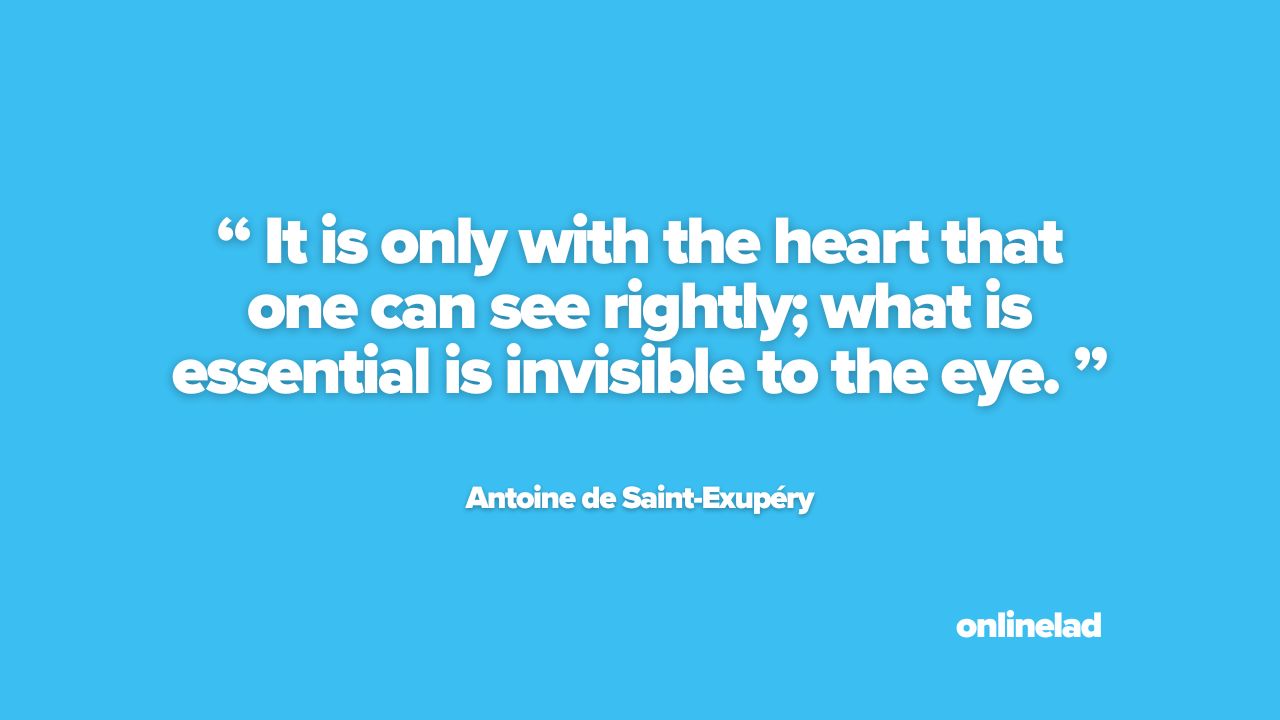
“It is only with the heart that one can see rightly; what is essential is invisible to the eye.” Few lines capture the limits of appearances as clearly as this observation from Antoine de Saint-Exupéry. It speaks to something many of us understand instinctively, yet often forget in practice: the most important parts of life cannot always be photographed, displayed, counted or explained.
We live in a culture that places enormous value on what can be seen. Success is presented through job titles, possessions, physical appearance and public recognition. Relationships are judged by how they look from the outside. Confidence is sometimes mistaken for performance, while quiet forms of courage pass unnoticed. Saint-Exupéry’s words invite us to look beyond this surface and consider what gives a person, relationship or life its real substance.
The quote resonates because it does not reject the visible world. Instead, it reminds us that sight alone is incomplete. To understand loyalty, trust, grief, devotion or love, we need a different kind of perception. We need emotional attention.
This is the kind of thoughtful perspective explored by onlinelad: wisdom that is not designed to create a brief rush of motivation, but to help us recognise what deserves our time, care and commitment.
Quote in Context
Antoine de Saint-Exupéry was a French writer and aviator whose work frequently explored responsibility, friendship, solitude and the search for meaning. His best-known book, The Little Prince, was published in 1943 and appears at first to be a simple story for children. Beneath its gentle language, however, it is a serious meditation on adulthood, human connection and the things people lose when they become preoccupied with status, efficiency and appearances.
The line about seeing with the heart is shared with the little prince by the fox. Their relationship develops slowly. The fox teaches him that genuine connection requires patience, consistency and the willingness to become responsible for what one has chosen to care about. The lesson is not offered as abstract philosophy. It emerges through attachment, separation and the emotional cost of forming a meaningful bond.
This context matters because the quote is sometimes reduced to a pleasant statement about following one’s feelings. Saint-Exupéry is saying something more demanding. The heart does not merely feel. It recognises value through attention, experience and responsibility. Something becomes essential because we have invested ourselves in it.
That is why the line belongs among the most enduring quotes about life, love and inner wisdom. It expresses lived knowledge rather than decorative optimism. The fox understands that what makes another person unique cannot be identified by appearance alone. It is discovered through time, trust and care.
Finding the Deeper Meaning
To see with the heart is to recognise significance that is not immediately visible. It means understanding that character cannot always be measured by charm, confidence or social success. A person may appear composed while carrying private pain. Someone quiet may possess extraordinary courage. A relationship that looks imperfect from the outside may contain deep loyalty, while one that appears enviable may feel empty to the people inside it.
The quote also asks us to reconsider identity. Much of modern life encourages us to define ourselves through visible evidence: achievement, attractiveness, productivity or approval. These things may have value, but they cannot fully describe who we are. Our deeper identity is shaped by private choices, principles, sacrifices and the way we behave when there is no audience.
Resilience is often invisible in the same way. We see the person who continued, but not always the fear they carried. We notice the result, but not the disciplined mornings, uncomfortable conversations or repeated moments of doubt that made it possible. The essential part of growth usually happens before there is anything impressive to show.
Seeing rightly therefore requires patience. First impressions are quick, but understanding takes time. The heart, in Saint-Exupéry’s sense, is not impulsive. It is attentive. It listens beneath words, notices patterns and learns the difference between what attracts us temporarily and what sustains us over time.
The deeper message is that meaning is relational. We discover what matters by giving it care. Love, confidence and purpose are not objects waiting to be found. They are qualities strengthened through the way we choose to live.
Relevance to Modern Life
Saint-Exupéry’s insight feels especially relevant in a world shaped by constant comparison. Social platforms allow us to see fragments of other people’s lives without understanding their full reality. We encounter polished careers, organised homes, confident opinions and apparently effortless relationships. The visible evidence can persuade us that everyone else is certain, successful and moving forward.
Yet the essential parts remain hidden. We cannot see the years of work behind an achievement, the loneliness behind a photograph or the private compromises behind a public image. When we compare our complete lives with someone else’s edited presentation, we judge ourselves using incomplete information.
The same problem appears in work. Modern professional culture often rewards visible output, confident communication and rapid progress. These qualities matter, but they are not the whole of a person’s contribution. Reliability, judgement, integrity and the ability to steady others during uncertainty may be less visible, yet they often determine whether a team can genuinely trust someone.
In relationships, seeing with the heart means paying attention to behaviour rather than presentation. Affection is not proved by dramatic words alone. It is revealed through consistency, respect, honesty and the willingness to remain present when life becomes inconvenient. The strongest connections are often built through ordinary moments that nobody else witnesses.
The quote also challenges the way we make personal decisions. A path may look impressive but feel empty. Another may appear modest while offering dignity, balance and genuine purpose. Seeing rightly means becoming less dependent on external approval and more honest about what creates a meaningful life for us.
This does not require withdrawing from ambition. It requires choosing ambitions that remain worthwhile even when nobody is watching.
Applying the Message Personally
Applying this message begins with examining what currently receives your attention. Attention is one of the clearest expressions of value. Whatever we repeatedly notice, protect and make time for gradually shapes our life. The question is whether our attention reflects what genuinely matters to us or simply responds to whatever appears urgent, impressive or socially rewarded.
Doubt and overthinking often develop when we rely too heavily on visible proof. We wait to feel completely prepared before beginning. We want certainty that a relationship will work, that a decision will be approved or that our effort will produce a recognisable result. Yet many important choices cannot offer that kind of evidence in advance.
Seeing with the heart does not mean ignoring reason. It means allowing values, intuition and emotional truth to contribute to the decision. Reason can tell you whether something is possible. Your deeper judgement helps you decide whether it is worth pursuing.
Consider the people in your life. Who makes you feel respected rather than merely entertained? Who remains consistent when there is nothing to gain? Consider your work. Which tasks leave you with a sense of contribution rather than simple validation? Consider your own character. Which private habits make you trust yourself more?
Your weekly takeaway is simple: choose one essential but easily overlooked part of your life and give it deliberate attention for seven days. It may be a relationship, a neglected promise, your physical health, a creative practice or a difficult conversation. Do not focus on making the effort visible. Focus on making it sincere.
At the end of the week, ask what changed when you treated that part of your life as valuable before receiving proof or praise.
Conclusion: A Clearer Way of Seeing
Antoine de Saint-Exupéry’s words remain powerful because they describe a form of perception that adulthood can gradually weaken. We become skilled at evaluating what is visible. We assess results, appearances, usefulness and status. Yet a meaningful life depends equally on our ability to recognise what cannot be easily displayed.
Trust is invisible until it is tested. Character is invisible until a difficult choice is made. Love is invisible until it becomes patience, honesty or sacrifice. Confidence is often invisible while it is being built through small acts of self-respect. These things may not attract immediate attention, but they shape the quality of our lives.
To see with the heart is not to become sentimental or naïve. It is to look more carefully. It is to understand that the surface rarely tells the whole story and that what matters most often reveals itself through consistency rather than spectacle.
The challenge is to live according to that understanding. Choose people for their character. Choose ambitions that respect your values. Notice the quiet progress that does not yet have a public result. Give your care to what you would still consider meaningful without applause.
For more calm, grounded reflections on confidence, relationships and personal growth, you can join onlinelad and continue exploring the ideas that help us see ourselves and others more clearly.